Sep 24, 2011

The Rule of Three

It is hard to define precisely what the universe is, or what our existence means, but one thing I am sure of is that it is made of patterns. The thing is that it is quite hard to see these patterns, for they appear in a number of unconventional ways, that is to say, it is difficult to see patterns that are not the basic patterns we need for our survival.

One such example is the rule of three. I does seem to be very vague or general, but I see it as one of the most basic patterns out of which others unfold. Astrology explains that this rule of three is divided into the Cardinal, the Fixed and the Mutable. With one of each for each of the four elements (Fire, Earth, Air, Water) we have the resulting twelve signs. Aquarius, for instance, is the Fixed Air sign, and it displays characteristics of both.


We can, however, see how this patterns shows itself in different manners. Let us consider for instance the cycle of rain. The Cardinal rivers flow until they reach bodies of water or underground reserves. Interestingly, the Cardinal Water is Cancer, and crabs dwell in or near fresh water, or close to the coast. The water then lies in the Fixed body of water until it rises and becomes a Mutable cloud. The clouds are moved by the Aquarian wind, ruled by Uranus, god of the masses. Of course, two frequent descriptions of Aquarians and Pisceans is that they have their head in the clouds.

This pattern can be found in the fauna as well. The most obvious is the cycle of life of the butterfly. It starts out as a caterpillar (Cardinal), then transforms into a cocoon (Fixed), out of which comes the winged (Mutable) butterfly. The butterfly is a recurring theme here in NoMII, naturally. The cycle works both ways, though, and we see it in pretty much every living species. The Cardinal Egg becomes the Fixed (cannot fly) chick, followed by the winged (Mutable) chick. A human being starts out as a Cardinal baby, turns into a Mutable adolescent and ends as a Fixed adult. Trees are first Cardinal seeds, then grow (Mutable) into full-grown Fixed plants. Insects go from Cardinal egg to Fixed larva and then Mutable adult.

Of course, this doesn't mean that the lengths of these parts should be equal. A man is usually an adult for much longer than he is a baby, for instance. But this fundamental division in three is present everywhere. Matter exists in essentially three phases: Cardinal liquid, Fixed solid and Mutable gas. Even God is divided into three: the Cardinal father, the Fixed (i.e.: comes to Earth) son and the Mutable Holy Ghost. Notice in the picture below how the godhead is divided into three parts, with Jesus carrying a wooden (Fixed) cross and the the Holy Ghost depicted as a winged (Mutable) dove.

Green = Earth, and Cardinal Earth is Capricorn (= old man/father)
Red = Fire, and Fixed Fire is Leo (=jesus)
Yellow = Air, and Mutable Air is Gemini (=messenger-bird)


We can consider, speaking of religion, the division in three between Hades, (Middle) Earth and Olympus. Hell is frequently associated with caves, and rivers are all over it, making it clearly Cardinal, while Heaven is in the clouds, that is, it is Mutable. We are left stuck (Fixed) here on Earth for now.

There is also the essential family unit of Fixed father, Mutable Mother and Cardinal child. The child then becomes either Fixed father or Mutable mother, who then creates another Cardinal child, and so on and so forth. This is where it becomes interesting to consider mythology in archetypal terms, that is, based on the fundamental patterns of the Universe. The pattern is God, simply. Or, if you prefer, God is the pattern. God is not a separate, individual mind, but just a way of showing the essential underneath it all.

This reminds me of the connections I was trying to make between the Planets and the Greek gods of old, which are just different manifestations of a pattern of a higher level. It is hard to really see all of this because our minds are so focused on the three spatial dimensions. Putting all of this into words is quite complicated (thanks Mercury in Pisces), but hopefully this will all give you a glimpse of how I see things, and a (Cardinal) seed will be planted in your brain, growing (Mutable) over time until it becomes a coherent (Fixed) idea.

The most basic pattern is the pattern of two (Yin-Yang, Sun-Moon, dualism and all that jazz I've been talking about), which unfolds into a double pattern of two, that is a cross (gee, where have I seen that idea before?). Dr. Roderick Peters mentions in his book Living with Dreams this archetypal cross, explaining how we tend to divide allness into four, as Jung said. Quartering the circle, that is. This can be seen in the four elements and in the points of the compass.
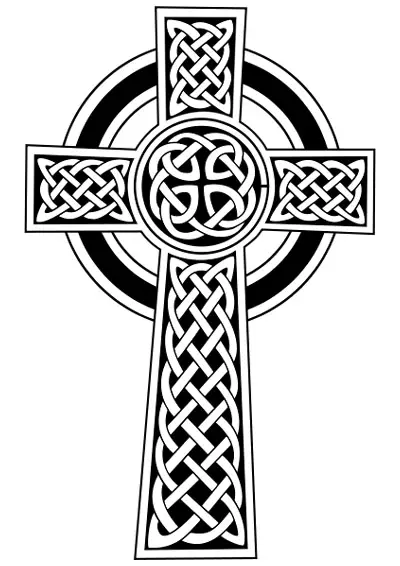
The Celtic Cross

If we apply the rule of three on the Sun Circle, we get the tetrahedron (i.e. four triangles, giving us the same number as the zodiac, the hours on a clock and so on do) inside the sphere, that is, the minimum and maximum volumes. Nassim Haramein gets into more detail about this, if you have the patience. Maybe you will disagree with some of what he argues, but that this idea seems pervasive is undeniable. Perhaps you can see a little bit where I'm going with this? I'm not entirely sure myself, but I'm sure we'll get there.

Update: right after posting I read in the Modern Mythology blog:
Geometries branch. The one world becomes two, and the two becomes eight billion—without ever ceasing to be two. As to the order that hides behind the panoramic flux, Heraclitus says, “The transformations of fire—first, sea; and of sea, half becomes earth and half the lightning flash.” (emphasis mine)

Cardinal sea becomes either Fixed earth or Mutable lightning and...oh, you get it

Jul 21, 2011

Psyche

As I mentioned before, the Greek word for 'butterfly' is 'psyche', which is also 'soul' or 'mind.' Therefore, butterflies are a symbol for the soul, and it is interesting to look at how butterflies appear in art, or even in the common world. For instance, I have just arrived in London, and the main exhibit at the Natural History Museum is about butterflies. Definitely a must-see while I'm here. The butterfly, incidentally, is one of the more common interpretations of some of the blots in the Rorschach test.


The legend of Psyche and Cupid is also worth a look. The story goes that Venus was awfully jealous of Psyche's beauty, so she sent her son Eros (Cupid) to make her fall in love with a hideous creature. He enters into her room, invisible, but Psyche startles him by waking up and looking him straight in the eyes, which causes him to accidentally prick himself with one of his arrows, making him fall in love with her.


Venus, angry at this, places a curse on Psyche, so that she is unable to find a husband. Cupid naturally hates this so he refuses to shoot at anything, meaning that no man or animal marries or mates. The world begins to become old, so after three months Venus allows Psyche to marry again, and all returns to normal. Psyche, however, still can't find a husband, so her parents see an oracle, who tells them to take her to the top of a mountain (Tower) and leave her there, for her beauty is too great for any mortal man. They do so, and then Zephyr, the West Wind, carries her to a valley, where she is attended to, and makes love to an invisible Cupid regularly.


Cupid tells her she can't see who he is yet, but Psyche's sisters convince her to try to find out, which she does. While she is doing so, however, she also accidentally pricks herself with one of Cupid's arrows, and falls madly in love with him. Psyche goes to Venus' temple after Cupid flies away, and asks her for help. Since she is still jealous, however, she orders Psyche to do a series of impossible tasks, but animals take pity of her for her beauty and help her. Interestingly, in one of the tasks she has to reach a location protected by snakes, and manages to do so thanks to an eagle.

Eventually, Venus tells Psyche that caring for her son, who has been depressed due to Psyche's actions, has worn some of her beauty out, so she orders her to steal some beauty from Persephone. Deciding that the quickest way to the Underworld was by dying, she climbs to a Tower to throw herself away. However, the tower itself speaks to her, showing her the way to the Underworld and what to do and what to avoid. She then successfully gets the beauty into the box given to her by Aphrodite. However, she peers into the box before returning it, and falls into a deep sleep as a result. Eros wakes her, and eventually Zeus solves the whole matter, turning Psyche into a goddess.

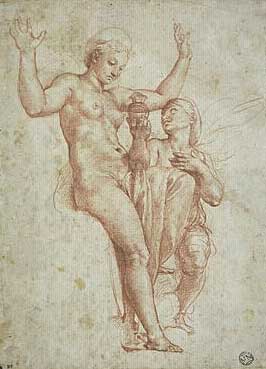
A painting by Raphael. Psyche is often depicted with buttefly wings.

Oh, and Psyche and Cupid have a daughter called Voluptas, which in Latin means 'pleasure' or 'bliss.' That is to say, the union of body and soul results in bliss. If we consider the Greek myths as symbolic (much like many consider the Old Testament to be symbolic) we see that they are not flights of fancy, but true Keys to understanding.

Since I mentioned the Underworld, I thought I would also explore some connections in that direction. The river Styx is the boundary between the Underworld and Earth (or Middle-Earth). It circles Hades nine times (in addition, the gods who break a promise sworn to by the river lose their voice for nine years). In the Divine Comedy, Virgil takes Dante through the nine circles of hell. Perhaps it might be meaningful to see Hades not as a physical hell, but simply the opposite of solar consciousness. In this perspective, Olympus would be more or less the equivalent to the Sun, the ego, while Hades is the unconscious, dark and murky. Remember Psyche has to wander into the Underworld before she can enter Olympus as a goddess.


Olympus is ruled above all by Zeus, but also by eleven other gods, bringing the total to twelve. This is, of course, the same number of signs in both the Western zodiac and the Chinese. It would be interesting to draw a parallel between the gods and the signs, but that is not the point here.

The twleve Olympian gods

Each sign is divided into three decanates, which correspond to the three signs of the element (earth, air, water and fire). We have thus a figure of three in one, or three from one (like Cerberus, who dwells in Hades), forming a tetrahedron. If we consider the six axes of the zodiac and the decanates of the signs, we have six double tetrahedrons, which consist of seven points if we consider the tetrahedrons as having the tip in common. That makes 6 x 7 = 42. I'll admit this is perhaps a stretch, but I'm still feeling my way around all of this, and it seems to fit Nassim Haramein's ideas, which I like a lot (though not necessarily 100%). Also, 42 could be seen as 4 x 2, that is, a tetrahedron twice.

But again the hand of synchronicity waves its wand. I started writing this post yesterday, and news came out that astronomers discovered a new Moon in Pluto, the planet named after our famous Hades. My money is on the name being Cerberus, but that might be just too deliciously sweet. Additionally, though it is unrelated here, Neptune recently completed one full orbit from its discovery in 1846. Neptune seems angry, though...perhaps because no one offered him any gifts? Oh, and just to add the icing on the cake, yesterday it was 42 years since Buzz Aldrin first stepped on the Moon...(and peed on it, which is interesting in light of this Pluto news, given that Pluto is the planet associated with the excretory system)

Jul 2, 2011

The Nine and the Tower

Ah, synchronicity never fails. This morning, after my post last night on the Rainbow Bridge, I stumble upon a new TV show called the Nine Lives of Chloe King. 9 lives of KK Chloe King, are you kidding me? The story is about a girl who, upon her 16th birthday (i.e. at the beginning of her 17th year) discovers that she has cat-like superpowers. It turns out that she is descended from a race of ancient gods who interacted with humans a long time ago (reference is made to Ancient Egypt, for instance). She is a Mai (My?), a cross between gods and humans. And here is where it gets interesting.


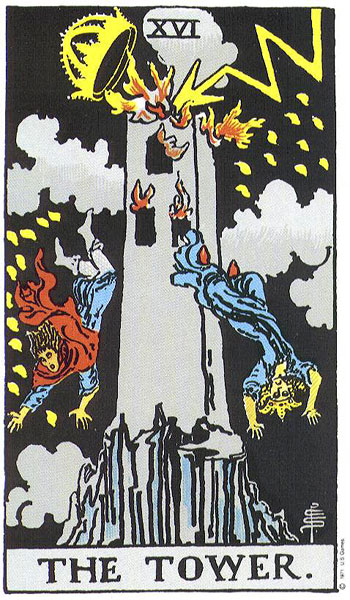
The poster itself is interesting enough, with the green eyes and three scratches, not to mention that the show starts at 9. I think, however, it's also interesting to take a look at some of the connections to tarot. Keeping in mind that Tuesday is the day of the god of war, that is, Mars' day, let's look at the description of the meaning of the 16th card of the major arcana, the Tower:


With Mars as its ruling planet, the Tower is a card about war, a war between the structures of lies and the lightning flash of truth. This is a card about anything we believe to be true, but later learn is false. This realization usually comes as a shock, hence, the violent image. It is, quite simply, that moment in any story where someone finds out a shocking truth, one that shatters their perceptions and makes them reassess their beliefs. (from Aeclectic Tarot) 

Why is this curious? Well, in the pilot for the series, Kloe King begins to realise that there is something different about her, around her 16th birthday. However, she also starts being followed by a mysterious scarred man, who it turns out is intent on killing her. Nine times. He actually succeeds in the first attempt, and how? By throwing her off a tower! This tower is Coit Tower, in San Francisco, where the show takes place (the same location where the old TV series Charmed took place). In addition to having some interesting murals, which remind me of the Denver airport murals, the tower always shows a 3-3 configuration:


And here's an interesting tidbit from Wikipedia: "On the season finale of the CBS reality television program The Amazing Race 16, airing on May 9, 2010, Coit Tower was the site of the first task of that episode of the program, whereby one member of each of the three final teams had to climb up and back down Coit tower, with the clue obtained from the top of the tower in hand, in order to proceed to the next task or clue."

Coit Tower was named after Lillie Coit, an androgynous socialite, and it was founded in, well, 1933! In addition, the murals are open to the public on Saturndays at 11 a.m. (11 = K). Etemenanki has some interesting thoughts on 11:11. To top it all off, there is a statue of none other than Columbus himself in front of the statue. Here's a link to a Google image search if you want to check out the Coit Tower murals.

So we have a cat-like warrior (who, in addition to the nine lives, has claws and feline agility) falling from the tower. The Ancient Egyptian word for cat is myw, which is probably why these Star Children are called the Mai. It's also interesting to note that cats were the personification of the Sun god Ra...

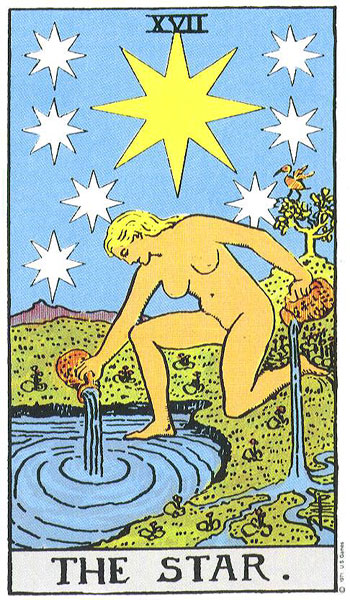
Returning to Kloe, she has just turned 16, ergo, has just started her 17th year of life. The 17th card in tarot is the Star. Once again from Aeclectic:


With Aquarius as its ruling sign, The Star is a card that looks to the future. It does not predict any immediate or powerful change, but it does predict hope and healing, even unexpected help to offer us sustenance in bleak times. 

It is after this moment that Kloe receives help from some fellow Mai. The association to Aquarius is also interesting in that Aquarius represents the shadow leader, in this case opposed to the main bad guy. Kloe is the saviour, the One/Neo/Jesus who comes to our world to protect us. She cannot, however, do it alone, and this is in the true spirit of Aquarius. As you can see in the card, there is the central, brightest star, but it is flanked by 7 other stars. Remember, Jesus had his apostles, and Neo had his own gang as well. This is not a Leo hero, who does it alone, like the fairy-tale prince charmings.

This is indeed the beginning of the Age of Aquarius. Will we see a Star-Child hero rise to save us?

Edit: just in case it wasn't clear, the connection to my previous post lies in the number 9 - the 9 lives of KK, the 9 worlds of Yggdrasil, death and rebirth as a higher consciousness... 

Jul 1, 2011

The Rainbow Bridge

a.k.a. the rabbit hole, a.k.a. the wormhole. I strongly recommend you watch this compilation by the author of the Sync Whole. It shows the essence of what I'm going to talk about. The gist of it is that we exist here as consciousnesses, but which can achieve a higher level (although it's hard to say what this higher level actually is, at least based on our current understanding), and this path is through the rainbow bridge, or to reach beyond the influence of Jupiter and Saturn, i.e. the collective consciousness. I began to ponder this after watching the movie Thor, which is essentially a re-reading of Norse mythology. The gods reside in Asgard, or this higher level of consciousness, and can be transported to Earth (Midgard, or Middle Earth - The Lord of the Rings was heavily influenced by Norse myths) via the Bifrost, the rainbow bridge. As a matter of fact, there are nine worlds, or states of consciouness (or what have you), all of which are connected by Yggdrasil, the tree of life. Obvious Tree of Life connections exist in Genesis, and in the film The Fountain, for example.


*spoiler alert - but if you haven't seen the movie, do so*
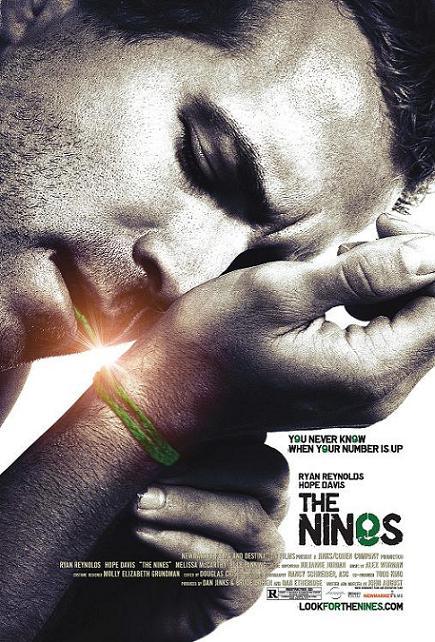
In the film The Nines, the main character, played by Ryan Reynolds (most recently the Green Lantern), is actually a higher form of consciousness - he's a Nine. Ergo, there are nine levels of consciousness, and we here on Earth are but in the middle of the path toward the ninth level.


Illumination is the key to attaining a higher level of being. The Arcade Fire song "My Body Is a Cage" (originally by Peter Gabriel) explores this theme:


My body is a cage that keeps me
From dancing with the one I love
But my mind holds the key

Ah, the infamous key. The key is the Eye/I inside, which resides in the mind. The questions of how one sees or reaches this is not the issue here, though. I know merely that there is the key to unlocking the Bifrost. It's interesting to take a look at a crop circle in the shape of a key:


I find the configuration of the spheres reminiscent of representations of Yggdrasil. Another idea I have been exploring lately is that of the butterfly as a representation of the soul (in fact, the Greek word for 'soul', psyche, also means 'butterfly'). Butteflies are intrinsically connected to rainbows as well, especially due to the variety of colours they display on their wings. Many artists have explored this idea, such as Salvador Dali (in fact, I have only recently really discovered Dali, and I am utterly fascinated by his work) and Vladimir Kush. Below is the latter's painting, Departure of the Winged Ship:


Another artist who worked with this idea is Stanley Kubrick, in his masterpiece, 2001: A Space Odyssey. When the protagonist reaches Jupiter, the first of the twin pillars of the gate to the beyond, along with Saturn, he goes through the stargate in a psychedelic path. Naturally, this scene brings up discussion of LSD, and it has been referred to as an 'acid trip'. Check out Christopher Knowles' The Secret Sun for thoughts on entheogens, ultraterrestrials (perhaps aliens, perhaps higher beings...) and myth, including wonderful musings on The Nines and 2001.


Perhaps the idea of a Stargate, already much explored in art and in the alternative/truth blogosphere, is not so much a physical one as a mental, or spiritual one. The band Train also goes to Jupiter...


It's hard to tell to which point the song's lyrics were consciously chosen. It even begs the question of whether there's a difference if an idea comes from an individual mind or from the collective mind. Either way, it's definitely there, whether it is recognised or not.

One of NoMII's favourite's, the Flaming Lips, also ride the same wave, in a video I've referenced earlier:


Remember the duration of 3:33? My original post talks about the number 33 as related to illumination, and it's interesting to note that 3 x 3 = 9...

One final remark, from the Bible (Book of Revelations, 1:17-18) - Jesus said: "I am alive for ever and ever! And I hold the keys of death and Hades."

May 14, 2011

The Lady in Black, pt. 4

I thought we'd venture away from fiction a little bit to analyse these symbols we've been discussing in more immediate incarnations, name in religion. We should start out with the obvious, that is, that there is Sun-worship and Moon-worship, often together, though not necessarily so. Solar deities abound, from Horus in Egypt to Helios/Apollo in Greece to Jesus, well, everywhere. Although it is not always the case, usually the Solar deity is male (exceptions include, for example, Sekhmet in Egypt. Likewise, the Moon deity is usually a female figure, although not necessarily always. In either case, they often appear together, joined together in the crescent moon-star/sun combination, as we see in Islam or again in Egpyt.
The Pakistani flag
Add caption
It would take far too long, however, to list all these connections, and certainly it's been done before. I thought it would be interesting, however, to take a look at some of the figures we see. If we look at Catholicism, there are two main types of servants of the Church: priests and nuns. And what do they usually wear?


Now, I know that there are priests who wear black, but it seems to me those guys are mostly from small parishes and work more with individuals than with the masses per se. If we look at large Catholic masses, the priest usually wears while. We thus have the figures of the White Wizard and the Lady in Black yet again (it's also interesting to note that it is very common for Islamic men to wear white and for women to don black burqas...). And what are their roles? Well, the priest is there to lead the worshippers and enlighten them; the nun, on the other hand, is secluded and mostly prays on behalf of others. Thus, we have the outward (white sun) and inward (black moon) devotees of God...interesting.

On the flip side of the God figure we have the Satan figure, which can also be divided into male and female aspects, the incubus and the succubus. They are creatures who have sex with humans of the opposite sex, usually while they are asleep or while the others in the house are asleep. Note that these are Lunar characteristics (it is important to think of this in a two-dimensional way, as I mentioned in the previous post: the dichotomy goes up and down AND left and right) which we might associate to Satan himself. The succubus is related to the Whore of Babylon figure while the incubus is closer to the figure of Satan, that is, the fallen angel.


What's the point here? Well, the way I see it, these, Sun and Moon, YHWH and Satan, woman and man, are all simply manifestations of an original Singular Consciousness, manifesting itself as dualisms which are in balance. That is to say, the concept of Yahweh would not exist without the concept of a satanic figure. The notion of good is meaningless without the notion of evil. They are in eternal balance. Likewise, we must recognise that these elements exist in all of us, in the sense that no one is purely good or purely evil (insofar as we can define those concepts, which is mighty hard).

In not accepting that there is a Satan inside all of us, just as there is a Yahweh, in believing that humanity is made of pure goodness and justice, we will just end up projecting this darker side of ourselves onto others. This is probably one of the most important reasons why injustice and greed seem to run rampant in society: we are so afraid to acknowledge our own dark side that we need others to express this side so that we may feel balanced. The average man is not inclined to take action against evil because he feels much better purging those sentiments in anyone other than himself.


A classic manifestation of this appears in the puritanical condemnation of sexuality. By repressing one's (entirely natural) sexual feelings, one ends up either covertly manifesting these feelings (in the form of swing clubs, strip clubs, pedophile priests, and so on) or overtly condemning them (i.e.: abstinence programs, the fight against gay marriage, etc...). This creates a fundamental imbalance than ends up manifesting in entirely destructive ways. By ignoring our dark, sexual, Moon sides, we end up transferring all the energy towards one edge or the other; we either radiate our Sun excessively or enclose our Moon, and do not allow it to express itself.

This whole idea is a central tenet in astrology, of course. The whole idea is to find a balance within ourselves. If we do not please our Venus (female energy of attraction) she will become angry, and this is what's happening to society as a whole. Just look at what happens to these energies when they are not manifested: pedophiles are denied their sexuality and end up molesting children; teenagers are denied their sexuality and end up pregnant at 16 (in fact, church youth camps are literal breeding grounds for teenagers).

The same happens, to give another example, to a denied Neptune. In not acknowledging that drugs are an important element in society, in banning them, their expressions end up distorted and Neptune becomes angry. We fail to recognise this in outlawing drugs, that is, we are denying a part of ourselves when we believe that drugs have no place in human society. After countless years of the War of Drugs and of drugs being illegal everywhere, has drug use around the world fallen by even a bit? Of course not. We have, though, many more overdoses and drug-addled rage incidents than we ought to. That is not to say that everyone has a need for drugs, on the contrary. But to deny those who do this need only leads to a destructive expression of their desire.


So if religions, at their outset, recognised that our world functions as a dual system, in which both Sun and Moon need expression, why can we not? It is time to see that God is not Yahweh nor Satan, but BOTH, and if either is denied we only end up getting the extremes, which are damaging to all. In the Odyssey, Poseidon becomes angry that he was not thanked after helping the Greeks win the Trojan War, and thus diverts Ulysses' journey so that it takes him much longer to finally get home. If a God (within or without) is not acknowledged, it will lash out in fury. The Greeks seemed to know this; how can we consider ourselves more advanced if, in spite of all our technological innovation, we are still entirely unable to deal with our inner selves? The Gods are not out there, they are inside us, whether we like it or not. Why do the incubi and succubi attack while their victims are asleep? Well, when they are asleep they cannot rationalise their sexual desires, and are thus much more open to them, practically inviting the demon to possess them. Perhaps it would be wise to think of mythological stories not as explaining the outside world, but rather the inner.

May 11, 2011

The Lady in Black, pt. 3

Following on the ideas of the previous post...

The four figures mentioned before can be organised a square, or rather a cross inside a square. One line of the cross would represent the male/female dichotomy, the other the sun/moon dichotomy. The four archetypes are then the four corners of the square: the female moon is the Lady in Black, the female sun the Lady in Red (the colours are no accident), the male sun the White Wizard and the male moon the Black Warlock, or Dark Magician.

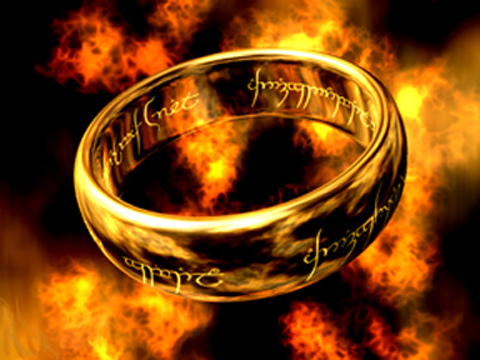
Remember the previous picture of Arwen, the Lady in Black in the Lord of the Rings series? She appears at a river, which is interesting given that water represents emotions and the subconscious, as does the Moon. I think it might also be appropriate to consider One Ring as the representation of the Lady in Red. It is temptation, selfish desire and greed embodied in Bilbo then in Frodo. It's hard to resist the seductress. A separate post would be required for a more detailed reading of the series, though.

From fire it was created, in fire it is destroyed...

The Lady in Red also famously appears in the Matrix. The Lady in Red, or the Lady in the Red Dress in this case, is the temptation to remain in the Matrix, to give in to lust and greed, and all the cardinal sins, really. It is the desire to remain materialistic, to give in to your emotions rather than understand them. Agent Smith is the Dark Magician, using essentially what is magic to replicate himself. It is the desire for ultimate power and control, regardless of the consequences. The other duo is easily Neo (WW) and Trinity (LB), although they also present, along with Morpheus, an interesting Father-Mother-Son triad (like Mars-Venus-Mercury, God-Holy Spirit-Jesus, Osiris-Isis-Horus, and so on), but that's also for another post.


This archetypal analysis is very simple, of course. The point is mostly to show the power of symbols, and how they show that many things are actually reduced to a few basic components. This is the same with astrology, tarot, and so on (the credible ones, of course). There's a level deep down, though, where all those become one and the same. Is it possible to even to glimpse that far down (or up, depending on your point of view)? Well, not by purely rational means, certainly.

Coming back to the relation between water and emotions/the subconscious. We call on our good friends Uriah Heep again to enlighten us:


It's interesting that I (and most of you as well) have been remembering my dreams more often lately, and often water is an important leitmotif. Friends have been telling me this as well. This should not be surprising, however, because Neptune is now back home in Pisces...prepare for more water during your slumber. But I digress.


If we think of the figures' connections to animals, it follows naturally the White Wizard is connected to the eagle, as show Gandalf and Jake Sully in Avatar. Conversely, the Dark Magician is associated to the snake, such as Voldemort in the Harry Potter series. Reminds me of the Medusa/Pegasus story...the Dark Magician also has Raven connections, and White Wizard to the Lion (cf. Aslan, astrology), while I'm inclined to think of the cat for the Lady in Black (Hermione and McGonagall in Harry Potter).

Well, I feel like if I keep going so succinctly this is going to get confusing. Then again, more figures are coming soon...

Apr 8, 2011

The Raven, or the Fall, pt. 1

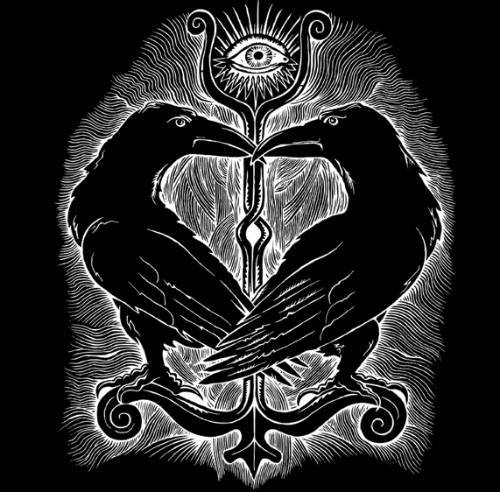
Today I have been led to do a little exploration of the myths behind the Raven (or Crow, obviously). I have come to see the Raven as the polar opposite of the Swan. They are the two sides of the same coin, dealing both with life and death. The Swan represents the ascent into heaven, the rebirth of the dead, whereas the Raven is the opposite journey, that of heaven down to Earth, or of Earth down to Hades.


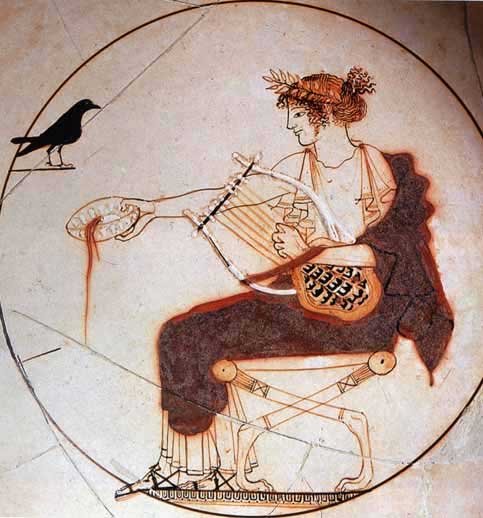
In Greek mythology, the Raven was an assistant to Apollo, the Sun God. Apollo was also the god of prophecy, and thus the Raven is associated to prophecy, that is, to the future. There are two versions of what happened to the Crow. In the first, he discovers that Apollo's mistress was cheating on him, and tells the Sun God. Apollo, however, is not happy, and accuses him of being a tattler. He then turns the Crow from silver (that is, a being where black and white are balanced) into black, and sends him into Hades. We have here, then, a story clearly associating the Raven to death, to the fall. The androgyne is now split.

In the second version of the story, the Raven is sent for water with a cup. He then loiters at a fig tree until the fruits are ripe (or, otherwise, eats the figs). Since Apollo would be mad about his delay, he carries it a water snake, or Hydra, and uses it as an excuse. The god doesn't buy it, though, and thus casts the Raven, the Cup (Cratera) and the Hydra into the sky. He punishes the crow by making him eternally thirsty, tantalisingly close to the water in the Cup, which is protected by the Hydra. So once again, while the Crow does technically go upwards, towards the sky, it is still a fall, for he is punished and eternally condemned (ergo, he goes to Hades, in a way).

Notice the lyre...


It is also interesting to look at the Crow's role in North American mythology. According to some beliefs, the Raven is the creator of the world. The story goes that the Raven got bored, so he took a stone and flew with it in his beak. He got bored, though, also of carrying the stone, so he dropped it, and it became the land where humans would live. Notice how here we also have a fall, this time down to Earth.

There is also the idea of the Raven as a trickster (curiously, in Norse mythology the Raven is associated to Odin rather than to Loki). In this myth, the Raven, once again bored, decides to free some creatures, men, from a clam (I don't think I need to explain the symbolism in that one). He sees, though, that they are scared and timid, and decides to return them to the clam, before actually deciding to search for the women, who were found in a chiton (a marine mollusk). The ancestral Raven, therefore, understands the dual nature of the universe.

We seem to come upon a cycle that would go somewhat like this: Raven -> Human -> Swan. The fall from heaven and the subsequent return. There is more:
In one common North American story, Raven plays a vain and regretful Chief in a moral tale somewhat analogous to The Little Boy who Cried Wolf.
As told by the Ktunaxa (Kutenai), the people tried to convince Chief Raven that everyone should get two lives. But Raven (also the bird/manitou Raven) selfishly preferred that people and animals only get one life. This is because Raven is known to like eating the eyes of carrion. As Raven was chief and had spoken, the decision was accepted.
The people were upset, however, and decided to make Raven regret his decision. Raven's son was killed in an arranged arrow target-practice mishap. A tree was felled that struck and killed his daughter.
When this happened, Raven tried in vain to reverse his decision so that everybody would get two lives. But he was reminded, "You are the chief, and you've already spoken".

Yet again the fall from two to one. The Raven thusly interrupts the duality, which leads to his (our) fall down to Earth, or even to Hell. In the Talmud, the Crow is one of the animals who decide to copulate during the Flood, and is thus punished. The duality of the Crow is broken, and he falls. Remember that the Raven is considered to be an unclear animal, that is, impure (incomplete, or imperfect)

It is interesting to come back once again to the Knights of the Zodiac. In it, the Crow Saint (Knight) is called Jamian (Hebrew for "the right hand of opportunity"). He kidnaps Athena, and is stopped by Seiya, the Pegasus Saint and protagonist. How does he die? He falls into a precipice. In the manga, he is defeated by none other than Ikki of Phoenix.


Returning to Norse mythology, the Raven is associated to Odin in the form of his two pet informers, Huginn ("thought") and Munnin ("memory"), who scour the world for information to bring back to Odin (don't forget Odin supplies the Gandalf, or White Wizard archetype).


So not only do we have once more the primordial Raven as a dual entity, we can make an association to the concept of humans living on Earth to learn lessons, to think and acquire memories, to learn, and thus leave the Samsara and return to Heaven once more. The poem goes (this is but one of many translations):
The whole world wide, every day,
Fly Hugin and Munin;
I worry lest Hugin should fall in flight,
Yet more I fear for Munin.
That is, it happens that one could lose the capacity to think, but it would be tragic for a soul to lose its memory. This could also be interpreted as a fear of losing the dual nature.It is also curious that the two Ravens are bestowed the gift of speech for their services.


 Elsewhere:
  •  In Chinese mythology, the Raven is a solar symbol (Apollo). Supposedly, the three-legged Raven lives in the Sun, representing its three phases (related to the astrological Cardinal, Fixed and Mutable phases);
  • In Aborigene legend, the Raven is punished (charred black) for trying to steal the fire from the Pleiades; 
  • To the Egyptians, the Raven represents destruction (fall);
  • In Celtic lore, Ravens are associated with the Morrigan and Morgan le Fay, in addition to being tricksters. The Crow is also the favourite of the Sun gods of the region. 
 Furthermore, Ravens are associated with astral travel, as in the following chants:

I shall go into a crow
with sorrow and such and a black thraw
And I shall to in the Devil's name
Until I come home again!
---
Crow, crow, crow God,
Send Thee a black thraw
I was a crow just now
But I shall be
in a woman's likeness even now
Crow, crow, crow God,
Send Thee a black thraw!
Ravens are, as mentioned before, prophetic birds. The old rhyme says:


One for bad news,
Two for mirth,
Three is a wedding,
Four is a birth.
Five is for riches,
Six is a thief.
Seven, a journey,
Eight is for grief.
Nine is a secret,
Ten is for sorrow.
Eleven is for love,
Twelve - joy for tomorrow.

Twelve, just like the Zodiac, and the number of hours, and months, and so on. The first two are particularly interesting.

Well, that's it for now, but I'll be revisiting the figure of the Crow, especially as it relates to the Swan, and possibly other symbols.