Showing posts with label Movie Analysis. Show all posts

Jan 26, 2014

Ender's Game: the Return of the Repressed


The appeal of science fiction, as opposed to contemporary or historical fiction, is that it offers the reader a objective 'space' between himself and the narrative. That is to say, setting a story in the future or in an alternate reality frees us from the biases of our 'collective present' or 'collective past'. So, for instance, if  the raw story of Ender's Game had taken place during World War II, even if the skeleton of the story were exactly the same, we would necessarily see it through the lens of history and apply the biases we've inherited. Jews or Germans who otherwise may have been put off by the context may appreciate it freely.

This is, of course, another way of stating the old axiom of science fiction, that it is about the present, not the future. The 'future' is merely the place from which we look back at ourselves. It is a tool that allows us to bypass the usual defense mechanisms, and it provides us with objectivity, much in the same way a psychotherapist does. So Ender's Game is a story about us, about now. It is a story about the return of the repressed and the search for the Self.

Before we dive into it, though, I suggest you take a look at the Fourfold Youniverse series (pts. 1 and 2) to get a basic idea of the fourfold functioning of the psyche. Here is a quick scheme - the four elements represent the four functions:


For those who don't know the story, here is a quick synopsis (very spoilery, but about the same as watching the movie in terms of being exposed to the plot twist).

The Earth is one day invaded by an alien* fleet, and all seems lost until a brave hero called Mazer Rakham sacrifices himself to disable the invaders. They are repealed, but this puts the powers-that-be on Earth on high alert. They create a training program wherein they abduct, to use a relevant term, the brighest and ablest children on Earth, and send them to a boot camp where they will be trained in space warfare, to prepare for the inevitable return of the non-descript "Buggers" ("Formics" in the movie).

Andrew Wiggin - Ender - is one such child. His older brother Peter and older sister Valentine were rejected from the program for being, respectively, too brutish and too loving. Ender, however, demonstrates incredible boldness and strategic acumen. He shoots up the ranks, watched over by Col. Graff. Eventually, he graduates and is taken to his real training, where he and his fellows confront simulated scenarios.

All the while, however, Ender is tormented by feelings of isolation, and his siblings are always in his mind. His playing of a "mind game" - an attempt by the military psychologist to keep track of his psyche - eventually leads him to having visions of the Bugger queen. As his training advances, he discovers not only that Mazer Rakham may not have been quite who he thought, but also that the army is preparing not for an eventual attack, but for a pre-emptive attack on the Bugger homeworld, a "war to end all future wars".

The climax comes when Ender discovers that his training was not, as he thought, a simulation, but the actual battle taking place. He was, in truth, the commander of all of Earth's fleet. He had not destroyed a virtual planet but a quite real one. Needless to say, he is torn apart by the idea that he has committed genocide, and sets off to find a new planet for the queen egg he found thanks to his 'psychic' link with the former queen.


In sum, the turning point of the story is when Ender realizes that the war he had been fighting had not been for survival, but for satisfying the aggressive impulses (Aries) of Earth's leaders. That is to say, Ender is confronted with the 'morality vs. ethics' dilemma: do I do what I do because I believe it's right, or do I do it because that's what I'm told is right?

This dilemma is the central aspect of the story which will be psycho(astro)analyzed, and it is represented in the vertical axis of the above scheme, with the military signifying 'ethics' and the buggers signifying 'morality'. However, let's take a look at the auxiliating functions represented by Ender's older siblings.

Peter and Valentine Wiggin, having come before Ender, represent the 'already there' functions which Ender needs to develop. Peter is the unrefined animus: he was expelled from battle school because he could not control his aggressiveness; Valentine is the diametric unrefined anima: she did not go further in battle school because her aggression was too contained. This is why they appear in the horizontal axis: in an astro(psycho)logical chart, the Ascendant of a male human (Ender's case) signifies his animus/masculine side, and the Descendant his anima/feminine side.

They are attributed the 'adjectives'** of Cancer and Capricorn: Peter has a complete disregard for social norms and rules, whereas Valentine is too self-controlled - these are classic "dark sides" of the signs. They are, however, absolutely essential as Ender navigates the hierarchy of battle school. His path succeeds exactly because he is able to 'balance' (notice that Libra appears at the bottom) aggression and containment. His actions, though, are still at the service of his Aries 'masters' rather than of his Libra 'conscience'.


"My daddy's taller than your daddy!"


It is interesting to note that author Orson Scott Card was born during a T-square in the cardinal signs: Jupiter in Aries opposing Neptune in Libra, both making a square to Uranus in Cancer***. He was thusly, as a writer, a vehicle of sorts for the collective consciousness; Ender's Game is clearly more of a collective catharsis than a personal one, considering that Card's overt homophobia shows how he still has a long way to go when it comes to "refining the superego".

Returning to our scheme, now it's time to take another look at the top of the cross. Throughout the story, it is perfectly visible how Ender is a puppet of the military, personified by Col. Graff - visible except to himself, of course. This is a good example of the repressive action of the nomos/superego. Any questioning on Ender's part is quickly met with an answer about the "greater good". This is, in theory, a perfectly good answer, were it not for our propensity to throw the 'soul'-baby out with the 'unrefined impulses' water.

One of Ender's strategies as he climbs the military(/corporate) ladder is to beat his opponents in such a way that others will be afraid of making a move on him. As we know, though, as above, so below: he's just doing what 'mankind' as a whole is doing to the Buggers. In other words, what's taking place in the 'war theatre' is merely a reflection of what's going on in his 'mind's battleground'. So if the military signify the repressive and powerful, what 'shadow' do the Buggers come to mean?


Kafka would know


In psychoanalytic theory, the 'monsters' in our imagination represent the unacknowledged libidinal forces within an individual's psyche, whose appearance might upset the social or familial environment. A simple example is a little girl who has terrible nightmares about a werewolf after being repeatedly cut off from contact with her sensuality. Thus, the Buggers represent that aspect of Ender which has been repressed since before his birth - his thinking, peace-making function, represented by Libra.

Why do start the clock before his birth? If Ender had not been born at the time of the Bugger invasion, then this is an event that took part during his gestation: his mother's thinking function had been repressed (no dictator/"president" likes to be questioned) to an extent that the repression was transferred onto him during that pregnancy - after all, a baby is made up of the 'stuff' that its mother 'ingests' during pregnancy. It's worth noting Orson Scott Card was born in 1951, when the repression of thinking that was made necessary by WWII was still fresh in everyone's minds.

You don't have to be Freud, though, to know that our impulses can only be repressed for so long. The various neuroses that we see every day are reminders that, try as might to 'civilize' ourselves to the utmost, our 'dark sides' will not be denied. In Ender's case, his need to understand the Buggers so as to be able to defeat them shows how he started to 'rescue' his thinking function (his 'screw-the-system' Cancer Ascendant leads him naturally to his 'let's-think-first' Libra IC).


Ender's thinking function is also neatly represented in the "mind game" he plays in his free time. Ostensibly a way for the military to probe his mind, via a 'game' that plays out a bit like a Jungian active imagination: a scenario where the unconscious plays out. They were, though, like any good Aries, a bit too hasty, because the game ends up inadvertently bringing Ender into contact with his unconscious. They are a bit like parents who send their child to a psychotherapist in an attempt to control his behavior, without realizing that most of what he does in his sessions is criticize and question them.

And so, the Bugger queen inevitably appears in the mind game, and his thinking function begins to be brought out of the unconscious (where it was under the control of the nomos). Nevertheless, his "therapy" does not conclude before the human fleet is at the enemy gates. Here we have the nomos's last-gasp attempt at annihilating the instinct: the fleet completely destroys the Bugger planet. It's worth noting that the most destructive weapon ever built is called the "Little Doctor" - Ender, for all his power, is still subject to castration fears. Calling it the "Big Doctor" could invite the fury of a jealous colonel.

But of course, it's impossible to truly annihilate our instincts and our unconscious functions: the Buggers survive in the form an 'egg' containing a new, future queen. The difference, though, is that Ender has 'redeemed' his thinking function enough this time that his Cancer instinct (Ascendant) to nurture and protect can be correctly applied to both his 'inner-Peter/animus' and his 'inner-Valentine/anima'. His military training taught him the value of expressing his aggressively protective impulses, but it took "inner genocide" to teach him the value of expressing his self-controlled, rational side.


But if the Buggers initiated the conflict, how can they signify 'Libra-peace'? This point isn't really detailed in the movie, but the novel explains that the Buggers attacked only because they assumed that humans were not sentient because they did not express a collective consciousness like the hive-mind of the Buggers (thus the comparison to ants - "Formics") - that is, they 'thought' (Libra) about humans before they had the chance to have a 'real experience' (Cancer) of them. In other words, even the unconscious function of thinking needed some refinement of its own.

Yet we must not forget the value of the nomos. It is only thanks to his training and to the encouragement of his superiors that Ender is able to trust and access his intuition (Aries). Granted, the initial results were catastrophic, to say the least, but Ender will still have all of his strategic skills as he sets out to seek a new 'planet' for the Buggers. It is very easy to get caught up in the blame game and forget the fact that even peaceful countries need to have a standing army.

The role of the nomos is to provide us with the resources we need to carry out our lives, but Ender's Game reminds us that it is very important to allow the heiros, the connection to our Higher Self/greater-than-sum-of-parts-soul, to ask exactly whose battles we are fighting, lest we end up committing 'xenocide'. This term describes not only what the human military commit in the story, but also what our superegos attempt to do to our own primal instincts. The best they can do, though, is to repress (much like the Buggers cannot be truly annihilated) - and the repressed always returns, causing trouble that's proportional to the repression.

We must all be Enders then - to 'end' the dominance of arbitrary rules, and to 'end' the unrefinement of our unconscious functions. We try to play whack-a-forbidden-mole, but the minute the hammer comes down another mole pops up 'from the underground', as it were. If we allow our superiors to dictate our actions without balancing their 'orders' with our 'conscience', the only possible result is a "Bugger" invasion. Just ask Robert A. Heinlein.


* Ridley Scott knows all about the 'aliens' in our minds;

** If we were to make an analogy between the elements of a chart and the elements of syntax, we would have the houses as the archetypal 'nouns' of the zodiac, while the signs would be the 'adjectives' - thus, we can describe a 5th-house cusp in the sign of Taurus as "patient/slow self-expression";

*** Card's birth time is unknown, but my bet is that his Ascendant is somewhere in Cancer - probably near Uranus, given his propensity to shock the world with his homophobic views;

Oct 20, 2013

The Fourfold Youniverse, pt. 2: the Elemental Man

In the first part of the series, I discussed the division of reality into the four elements. The four elements, together with the three essential qualities, give us the twelve signs of the zodiac. This provides us with another reason to refute astrology as the heavens somehow causally affecting events on Earth - the zodiac is about the intrinsic qualities of life on the planet (perhaps of all reality, but I doubt that - either way, who's to say what astrology is elsewhere?).

This is where the value of Fire reveals itself: most are busy making a microscopic analysis of the facts, and only a few care to take a bird's-eye view of the matter. When you look at an ant, it's hard to understand its purpose, why it does what it does, but look at the colony as a whole and you'll start to get the picture. Likewise, while there certainly is some worth to a dividing, detail-oriented approach, the truth can only be seen if the results of that approach are compared with the results of a macro approach.


At ground level, it's just a weird neighborhood

I've always had a soft spot for movies when it comes to art, which is easy to tell. The reason is very simple: insofar as art is an expression of the collective unconscious, movies are the way it can be done with the element of time (it is possible via other art forms, such as photography, putting pictures in a chronological order, but if you do that, it starts to become less photography and more cinema anyway). Movies, then, tell the stories that we as a whole dream about - stories that always express the archetypes of Earth, just as your dreams express your own archetypes.

Coming back to psychology first, though, let's take another look at the four functions of the psyche. I have always felt that the standard psychoanalytic dynamic of ego/superego/id was somehow lacking (not to mention that the id is critically misunderstood - but don't take my word for it), just as the traditional Father/Son/Holy Spirit division also lacked its fourth element. Well, until the assumption of Mary in 1950, that is.

Thus, in order for my own concepts of the psychoanalytic dynamic not to be confused with the classic, I'll be giving them different names - which of course carry their own load, but I'm not going to invent gobbledygook either. So the superego and the id, as a whole, are more or less clearly defined, which led me to see the ego as actually being a conflation of two opposing factors. We have then:


Nomos then corresponds to the superego, and heiros (meaning 'sacred') to the id. It should be clear that, where Freud saw a depository of repressed memories and desires, I see rather a connection to that part of us which lies outside of space and time - our soul, as it were, but not that ghosty thing inside your body that a lot of people will imagine. The function of the element of water in our psyche is to act as a connection to our higher self, as it were, which includes, of course, our memories. It's easy to see that memory retrieval is hardly logical, or even coherent. The heiros is your guardian angel, that voice inside your head - which is a part of you, not someone else, remember - that tells you to do something crazy that turns out to actually work. Yes, the devil is part of the sacred too.

That leaves us with eros and logos. Eros, the element of fire, represents our desire, our will, our consciousness, not to mention our ability to make choices. Without the eros, the individual will be nothing more than a slave to the outer rules, the nomos - he won't even move, really. However, it's certainly not easy to make choices, especially when the inner feeling conflicts with the outer norm. This is where the logos comes in: it is the mediator between the nomos and the the heiros, the helper, the logical thinker.

The eros is also what we would consider to be our identity. An identity, something that differenciates you, is what allows you to separate from the nomos. However, all the archetypes are within us, even the ones we consider diametrically opposed to our identity. We thus need to project those conflicting archetypes, to use others as a way of expressing that archetype without feeling like you lost yourself. That's where the logos comes in - it acts as a mediator between yourself and that part of yourself which are most distant from. This is why the logos will usually appear in one's dreams as a person of the opposite sex - as Jung would call it, the anima or animus of the individual.

Cupid and Psyche, by William Etty

So if all the characters in your dream are just the different aspects of yourself, it would seem to make sense to take the characters in a movie as the different aspects of a single individual - usually the main character, but it doesn't really matter who the dreamer is, since movies are telling collective stories, to which each of us can relate in varying degrees. This explains why there is romance in just about every film - we are unconsciously attempting to get in touch with our other selves.

Take the classic romance story. Boy meets girl, they fall in love, but some form of authority (parents, customs, governments, etc) comes in the way, and they can't be together, until boy receives help from an unlikely source and they are able to defeat the authority and finally get together. In order to become individuals, we must separate ourselves from the collective, the outer rules, and choose our own paths, and that is why movies are the predominant art form of the post-modern age. We all want to be individuals, desperately, to have our own story.

It's the same for everyone: in order to grow and to protect ourselves from the chaos of earthly life, we need to have a sense of structure and order, which we get from our parents, teachers, governors, etc. As we continue on the journey, the world itself changes, and sometimes the old rules don't work out anymore. It's not easy, though, to change the structure, because it makes us feel helpless, powerless. The help we need is also within us, however. This is where the heiros comes in - it's that part of yourself which allows you to reform the nomos, as it were, a process that will always involve pain and loss. Very often, we are depressed because we recognize intuitively that something is not right, but we cannot seem to know what. It's hard to tell which rule is wrong.

However, we usually don't realize that the losses and pain we go through serve a purpose, and are there ultimately for our own benefit (which can, admittedly, be hard to see). Most believe that the ultimate purpose of life on Earth is happiness, but if you look at the system objectively, you'll be hard-pressed to find indications that this is actually the case - in fact, it would be much easier to argue that the very purpose of life of Earth is suffering and difficulty. But then, if it were easy, it would be no fun.


The four functions of the psyche correspond to the four quadrants in an astrological birth chart. Thus, a person who has many planets in the 1st quadrant (1st to 3rd houses) will generally be rather eros-driven, and will be particularly prone to the qualities and defects of eros, that is, particularly concerned with their own identity and their own will. There is a particular paradox that occurs, then, when the 1st quadrant is filled with planets in the signs of the 3rd zodiacal quadrant, for example the person with a Sun in Libra in the first house. However, these opposing qualities allow the person to reduce the paradox, the complexio oppositorium, to its core. So, to spin the circle back to movies one more time (I include TV series in the category, of course there are distinctions but the medium is essentially the same), let us concretize, and see an example:


Elementary. Look at that word again, and remember that it means 'simple'. Archetypes are elementary. Well, well. So if we psychoanalyze the series, so to speak, we should be able to see the dynamics quite easily - and indeed, they are in your face. The Sherlock Holmes character was inspired by Edgar Allan Poe's C. Auguste Dupin. Poe was the grandfather of the modern mystery story, and in one of the stories, "The Purloined Letter", the eponymous letter, desperately sought by the police but never found, was in fact hidden in plain sight. Likewise, the mysteries of the universe aren't locked away in some secret alcove, rather, they're right there on TV, looking at us.


Here is the IMDB synopsis, if you haven't seen the show:

Sherlock Holmes (Jonny Lee Miller) is a recovering addict who meets Joan Watson (Lucy Lui) as his 'sober companion'. Initially their relationship is strictly professional, and somewhat frosty, but they grow to understand and work with one another, eventually forming a friendship and partnership. Together they assist Captain Gregson and Detective Bell of the NYPD, where Holmes' observational abilities and deductive talent unravel a series of complicated cases.

Alongside his police work, Sherlock struggles with a past he left behind in London involving an ex-girlfriend Irene Adler, a 'nemesis' in Moriarty, and an absent father.


Let us imagine then, that all four main characters (for dream-interpretation purposes, two people can represent the same character) represent the four elements. Watson is the main character, the series is about her, not Holmes. She was originally a surgeon, but became a sober companion, and then a detective after meeting Holmes. All of those are about helping other people. Additionally, she possesses many characteristics associated with Libra: she is generally cheerful and pleasant, she has a good sense of fashion and tends to be indecisive at times, and she's quite sympathetic.

Holmes, on the other hand, is impulsive, prone to temper tantrums, aggressive and selfish, characteristics of Aries. Since the main character here is a woman, it stands to reason that the logos would be of the opposite sex. Furthermore, he's British, that is, a foreigner, and foreigners in dreams represent aspects of ourselves that are very strange or distant to us. Watson, representing the Libra archetype, has a natural tendency to reject Aries characteristics, but there comes a time in everyone's life when they must confront their logos, the aspect of ourselves we project on others. This becomes particularly poignant during our 40s, and is what most people mean when they talk about midlife crises. Yes, Watson is middle-aged (Lucy Liu is 45).

Captain Gregson and Detective Bell, the police generally, represent the heiros of the dreamer. This might seem counter-intuitive at first, because usually the police are the agents of the nomos, of the repressive authority, but if we have an inverse chart then that's what fits. Either way, you'll notice they're not the prototypical cops: they're helpful and protective at times, and challenge and confront at other times. The role of the heiros is double, at once defending and criticizing, but the objective is the same: to get the dreamer on the right path, whichever that might be. I'll leave you to figure out how Moriarty is Cancer - to do so myself would be to spoil the first season.


Remember that clothes broadcast our identities

So, if the nomos is the bad guy, what's it doing there? Well, we all have our shadow side. It might seem right to suggest that Moriarty is amoral, but I would argue otherwise: Moriarty is unethical, not amoral. He doesn't play by anyone's rules but his own, but he has his own rules. The nomos exists because it is our structure, it is the stuff that we are made of. Without an internal structure, we are at the mercy of the elements (har, har). This is why Capricorn, the sign of the nomos, is represented by a mammal, which has a bone structure, and Cancer, the sign of the heiros, is represented by a crab, which has an exoskeleton instead (that is, a soft interior). It is only with an inner structure that we survive the outer conflicts, and with an outer structure that we survive our inner conflicts.

The nomos has the resources that we need at our disposal. In the case of the show, Moriarty has all the deductive resources, let's say, that are necessary, as evidenced by the fact that he is constantly outsmarting Holmes. Holmes himself is the epitome of rationality, and thus accurately represents the logos: our critical faculty, our ability to judge facts objectively, to get outside our own skin, as it were. The thing about the logos, though, is that it is completely amoral, in the sense that any choice can be rationalized - it's a cliché example, but the nazis justified their actions with science too. Thus, just as Watson needs to Holmes to be an objective analyst, Holmes needs Watson (and the cops) to be his moral compass.

It's fitting that the show is about assassinations, too. When someone is nomos-possessed (and note how Watson is extremely subservient to her parents), that is, when the superego is running the show, he or she will not hesitate to "kill" any aspects of self that are a threat to the status quo. However, a human being, just like the Earth itself, is a self-regulating system, and that's where the logos comes in. Its function, as I mentioned earlier, is to act as a balancer between the nomos and the heiros. When it detects that the nomos is unfairly powerful, it comes to the rescue - in this case, in the form of an Aries investigative detective. It's interesting to note that Scorpio (Mars rules both Aries and Scorpio, fyi) is the sign of criminal investigations and death, but also of psychology itself. It is also the sign of sex, which is a literal representation of the reduction of the complexio oppositorum.

Before teaming up with Watson, Holmes had been in rehab after excessive use of heroin (there's that Scorpio again). Frequently, people who overdose on drugs, or attempt suicide in general, are doing so as a call for attention. The logos needed to get the eros's attention, and indeed it did. Previously, Holmes had lived in London - far away from Watson's conscience. Interestingly, Watson was hired by Holmes's father; interesting because the heiros and the logos compose the patriarchal, right-hand side of the wheel. After all, father is absent - there had, until now, been an excess of nomos and a lack of heiros.

If the role of the superego is to consolidate the individual, to establish the rules, it is the id's job to question those rules, in short, to reform the superego. To sum up the first season of Elementary, Holmes and Watson become gradually aware of the existence of Moriarty, who always seems to be two (or ten) steps ahead. In the final episode, and it's no spoiler to say this, they finally manage to outsmart and thwart Moriarty. Watson is finally able to begin reintegrating her broken self, and rid herself of the excess weight dropped on her by her parents. She has become the Elemental Woman.

May 11, 2011

The Lady in Black, pt. 3

Following on the ideas of the previous post...

The four figures mentioned before can be organised a square, or rather a cross inside a square. One line of the cross would represent the male/female dichotomy, the other the sun/moon dichotomy. The four archetypes are then the four corners of the square: the female moon is the Lady in Black, the female sun the Lady in Red (the colours are no accident), the male sun the White Wizard and the male moon the Black Warlock, or Dark Magician.

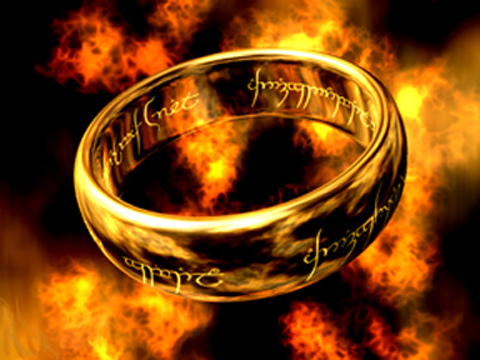
Remember the previous picture of Arwen, the Lady in Black in the Lord of the Rings series? She appears at a river, which is interesting given that water represents emotions and the subconscious, as does the Moon. I think it might also be appropriate to consider One Ring as the representation of the Lady in Red. It is temptation, selfish desire and greed embodied in Bilbo then in Frodo. It's hard to resist the seductress. A separate post would be required for a more detailed reading of the series, though.

From fire it was created, in fire it is destroyed...

The Lady in Red also famously appears in the Matrix. The Lady in Red, or the Lady in the Red Dress in this case, is the temptation to remain in the Matrix, to give in to lust and greed, and all the cardinal sins, really. It is the desire to remain materialistic, to give in to your emotions rather than understand them. Agent Smith is the Dark Magician, using essentially what is magic to replicate himself. It is the desire for ultimate power and control, regardless of the consequences. The other duo is easily Neo (WW) and Trinity (LB), although they also present, along with Morpheus, an interesting Father-Mother-Son triad (like Mars-Venus-Mercury, God-Holy Spirit-Jesus, Osiris-Isis-Horus, and so on), but that's also for another post.


This archetypal analysis is very simple, of course. The point is mostly to show the power of symbols, and how they show that many things are actually reduced to a few basic components. This is the same with astrology, tarot, and so on (the credible ones, of course). There's a level deep down, though, where all those become one and the same. Is it possible to even to glimpse that far down (or up, depending on your point of view)? Well, not by purely rational means, certainly.

Coming back to the relation between water and emotions/the subconscious. We call on our good friends Uriah Heep again to enlighten us:


It's interesting that I (and most of you as well) have been remembering my dreams more often lately, and often water is an important leitmotif. Friends have been telling me this as well. This should not be surprising, however, because Neptune is now back home in Pisces...prepare for more water during your slumber. But I digress.


If we think of the figures' connections to animals, it follows naturally the White Wizard is connected to the eagle, as show Gandalf and Jake Sully in Avatar. Conversely, the Dark Magician is associated to the snake, such as Voldemort in the Harry Potter series. Reminds me of the Medusa/Pegasus story...the Dark Magician also has Raven connections, and White Wizard to the Lion (cf. Aslan, astrology), while I'm inclined to think of the cat for the Lady in Black (Hermione and McGonagall in Harry Potter).

Well, I feel like if I keep going so succinctly this is going to get confusing. Then again, more figures are coming soon...

Mar 21, 2011

The Lady in Black, pt. 2

Continuing the idea for the first post about the Lady in Black, I'm going to talk a bit about her male counterpart, the white wizard. While the Lady in Red is the polar opposite of the Lady in Black, the White Wizard is what I'll call her complementary opposite. The Lady in Black opposes the Lady in Red in her intent, but with the White Wizard the opposition is in the means through which the intent is carried out.

The White Wizard is the Sun to the Lady in Black's Moon. While she operates in darkness, he is an action man, and isn't afraid of being in the spotlight. Their purpose is the same, but their modus operandi, so to speak, is certainly not.

The first example that comes to mind of this idea is, naturally, Gandalf, of the Lord of the Rings trilogy. We must make a distinction here, however, between Gandalf the Grey and Gandalf the White. The former was a wizard, yes, but he was still a mortal man, and actually fell to the Balrog; the latter, on the other hand, was otherworldly, and existed more as a spirit than as a normal man, much as the Lady in Black does.


The Wizard's opposite, I imagine, would be a figure such as the Black Warlock. Of course, these are all just manifestations of some divine will. In LotR this would be Sauron/Saruman.


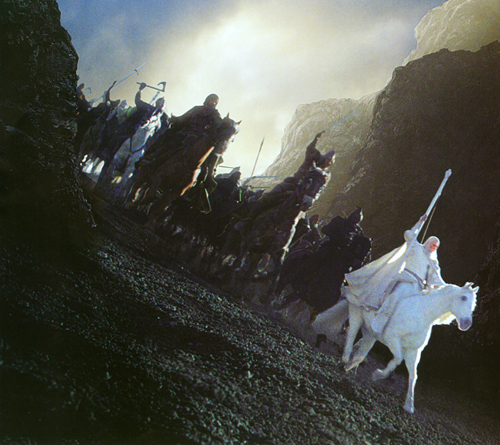
Notice how Sauron creates his army by means of cold, hard science, breeding these quasi-mechanical creatures out of factories. This is how this negative (relativistically speaking) side operates: by logic, cold science. This is in opposition, of course, to the subconscious, emotional way the Lady in Black and the Wizard act. In LotR, I believe we see the Lady in Black in Arwen. In the film, she first appears in order to save the Fellowship (riding a white horse, like Gandalf).

And with the required black garment

I have to watch the movie again in order to expand on these ideas a little more, however. Returning to the figure of the Wizard, then:


He is, of course, a magic man. He shines like the Sun and performs miracles. There is a parallel with the Lady in Black in that they both work with emotion (remember the Wizard inspires courage among men). Does this remind you of anyone?


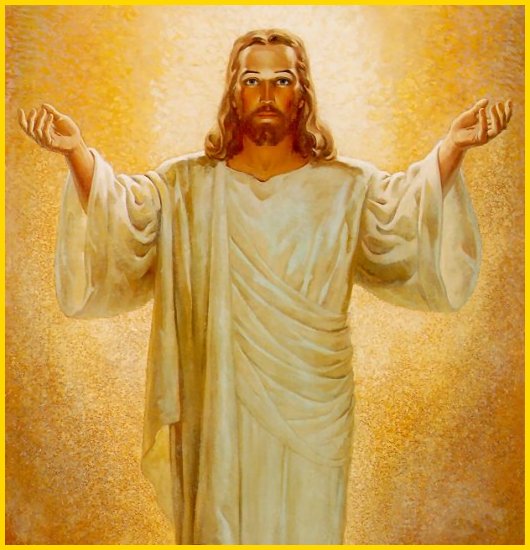
It's interesting that, like Gandalf, Jesus dies and is reborn, but he comes back different. He is no longer a mortal man, he is an embodiment of a supernatural force. And he comes, of course, to save men. The association to Aslan here is obvious, especially because C.S. Lewis did it on purpose. In Narnia, however, the whole resurrection thing seems a little clumsily handled.

The rest here is a little obvious, with the whole white-robes, shining thing and so on. More on this mythology in a later post...

Dec 25, 2010

The Brothers Bloom

At first, this film might appear to be simply a light comedy about con artists, but I believe it to be about much more than that: it is a film about illumination, about a man who is a fallen angel, who is to be rescued back into the pleroma (as I just saw, mentioned in the New Testament 17 times) – not necessarily literally, in the gnostic sense, the idea is what's important. Now, I know that some of the analyses I make are somewhat stretched, and some ideas will be more pertinent than others, but such is life.

A quick synopsis, courtesy of IMDb:
Brothers - older Stephen and three years junior Bloom - have been con artists since they were kids. Stephen is the mastermind, for who the intricacy of the story used in the con is as important as the positive outcome of the swindle. Bloom is the main character of Stephen's stories, the character he considers the anti-hero. As adults, they travel the world and never enlist the same people twice in their cons, except for their consistent sidekick, the mysterious and primarily silent Bang Bang, a Japanese woman who just appeared in their lives one day and who has a penchant for blowing things up. As Bloom hits his mid-thirties, he wants to quit the business as he is losing his own identity to that of the characters he portrays; he doesn't know anymore what is real and what is make-believe. Stephen talks him into one last con, the mark to be the eccentric, lonely but beautiful New Jersey heiress, Penelope Stamp. Penelope's primary past-time in life is to, as she calls it, "borrow hobbies": when she sees something she likes, she learns how to do it solely through reading books. As the brothers go through their final con on Penelope, three main problems may occur to thwart the plan. First, the brothers' former mentor and now arch enemy, Diamond Dog, may exact his long awaited revenge on the brothers. Second, Penelope may end up being more unpredictable than all their former marks. And third, Bloom, who has let love slip by in his life, may fall for Penelope. But through the process, no one ever really knows who is conning who.

The very logos of the production companies send us in the direction of illumination:


The movie barely begins and we already have a sun shining. The logo for SuMMit Entertainment appears. Not only does the idea of summit imply climbing to new heights, but the logo itself resembles an 'M' (M =  13th letter of the alphabet), which, coupled with the company's name, gives us three 'M's. The double 'M' could also be rotated to give us 33.


Once again, we have the sun shining (in addition to a man going north, or upwards, towards the sun) and 33 (EndgamE). I should have known this film was promising from the beginning.

Finally, the film itself begins. What's the first thing we see? Obviously, the sun rising.

  
We are then introduced to the eponymous characters. We have Stephen and Bloom. According to the director, Rian Johnson, the characters were based on James Joyce's Ulysses, itself based on the Odyssey. I believe there's more to it than that, however. Stephen means 'crown', which I find noteworthy, given that Stephen represents, in part, that which shackles Bloom to this reality. The meaning of his name will also be important in relation to Penelope. Curiously, the younger brother is referred to by their last name, and we never find out his first name. This is part of the reason that leads me to believe that Stephen is some sort of simulacrum of Bloom, a reflection of an aspect of his. In fact, I believe that Stephen and Bloom are two manifestations of the same being, with Stephen representing at once that which binds Bloom and that which saves him.

I don't think I need to go on about the meaning of their last name, do I?


We first see them at the ages of 10 and 13 (naturally, as I check IMDb for some info, it tells me the movie is up 13% in popularity).

The narrator explains how the boys went through several foster families, always causing mischief. Here we see Stephen's double role: on the one hand, he always protects Bloom (punching the foster father who hit Bloom), but on the other, he's the one who scripts Bloom's life.


Here we see one of their files. Interesting to note is the I56. I56 is, of course, 9-11 (I = 9th letter; 5 + 6 = 11), a highly resonant number. We also have another file: 77, Newton St. (as the story goes, Newton came upon knowledge, or understanding of reality, after the apple fell on his head, that is, after he was hurt). In these first few minutes of the film, we see two references to broken or maimed cats (the molested cat above, and the one-legged cat later on). Wiki tells us: “Several ancient religions believed that cats are exalted souls, companions or guides for humans, that they are all-knowing but are mute so they cannot influence decisions made by humans.”). Hmm, someone who knows all, but is broken.

Stephen, staring at the kids playing the park, says: “Playground bourgeoisies.” Rather advanced vocabulary for someone his age, no? In this scene, Bloom sees a girls whom he fancies, and here we will see their first con. The first thing that happens, however, is that Stephen pushes Bloom into the open, telling him to talk to the girl. This is the first moment where we see Stephen scripting Bloom's life, a moment which also shows us Bloom is lost on his own.


Their first con will then take place. It will have 15 steps. From this moment on, Bloom begins to live the life that is not his. Already in his first con, Bloom is disappointed. While he at first believed in the story his brother had made up, the sight of Stephen carrying the lamp saddens him as it reminds him that this just isn't real. Interesting that this moment happens as Stephen takes the lantern (light) deeper into the cave (labyrinth). Oddly enough, the very next scene after the title is a burning library, which ties into the Newton meme in the movie, as we will see in a second.

After successfully pulling this con, Bloom calls Stephen a genius, to which Stephen replies: “No, we're a genius!” He could very well have said “we're geniuses,” could he not?


In the following scene of a party thrown for the brothers, we are formally introduced to Bang Bang. I haven't been able to read her character too well. Curious that he refers to her as “our fifth Beatle” (Yoko Ono, of course, was also Asian, and, I suspect, a Lady in Black – I will delve into the Lennon/Ono story at some point). At this same party we hear the first reference to the Diamond Dog, who supposedly taught the brothers the art of the con in St. Petersburg. Diamond, of course, was the name of Newton's dog, who infamously set fire to Newton's manuscripts by upsetting a candle (remember the burning library scene and Newton St.). The affair in Russia ended badly, however, with Stephen poking out Diamond Dog's eye...Another interesting point in this scene is that Stephen injects “thematic arcs and embedded symbolism” into his cons. This whole movie is, really, a con.


Bloom is evidently unhappy, so much that he rejects the advances of a good-looking lady. In fact, he appears in two consecutive moments with a “gun” to his head.

In the scene to the right, the graffiti head is actually a door, which Stephen opens, producing a bang. Bloom finally dies in order to be reborn (note the light above Bloom's head in the first picture). It is after this moment that he decides he wants out, and actually abandons his brother before being reeled back in for a final con, which will provide his salvation, and cut his umbilical cord at last. Bloom even says he hates Stephen, and recognises he himself is “useless, crippled.” He seems to finally realise that he's “only ever lived life though these roles that aren't me.” He wants a “real thing,” something that has eluded him so much that he cannot even put it into words.

Bloom then retires to Montenegro (black mountain?), and three months later Stephen catches up to him. He convinces Bloom to embark on a new con in New Jersey.

The plane is, naturally, headed towards the sun.

Penelope finally appears, after Stephen tells Bloom the basic story behind their last mark. Penelope is Ulysses' wife in the Odyssey, and she waits for him for 20 years after he leaves for the Trojan War. A woman who waits for her king for 20 years...notice that this would make her 13 in the movie's timeline. Penelope is actually a lady in black, a woman who dresses in black, but who actually comes to save men from darkness. In this case, she is here to save Bloom from the shackles of that reality which is not his, and to bring him back to her, really. Her associations to enlightenment couldn't be clearer, and we see this from her very first appearance, when she is coming back home driving, of course, a yellow Lamborghini Diablo. The devil being Lucifer, the light-bringer.


She promptly crashes the car, showing her disdain for material things.

I found her outfit particularly noteworthy:

 
She is wearing an orange dress with a sun, but covered by a black poncho. In my opinion, this represents who she really is: an enlightened being, disguised as ignorant. The black poncho (dress, cloak) confirms her as a lady in black, who represents at once salvation from darkness and death (the two, of course, can be one and the same). Oh, and did I mention Penelope is 33 years old?

The whole lady in black idea is going to get its own post(s), naturally. The more I look into this, the more I find, and it doesn't make much sense not to explore it in further detail. One interesting fact is that there is a NASCAR track which is called “The lady in black” in Darlington, South Carolina (just like Charleston), but this is probably just an actual coincidence.

When Stephen explains the con to Bloom, he starts off by saying they are supposed to be brothers, antiquities dealers who are travelling the world, and the scene promptly cuts to the next, with Stephen saying “Bang” (another gunshot) and explains how it ends: “burst of violence, and a moment of truth on the beach.” Yet again, death and illumination. The con is supposed to end in Mexico, which is traditionally associated to beaches and, therefore, the sun.

Bloom quickly deduces that “this is about me, right.” Yes, Bloom, it has always been. This is during a moment in which Stephen kills a fly, which symbolically represents death as well. Curiously, Stephen then tells Bloom that “I've never been able to give you what you really wanted.”

 
And then Stephen shows Bloom the Ace of Spades. This is funny because I saw something recently which explains how aces became 'aces high', that is, higher than the king, during the French Revolution, representing the rise of the plebs (Bloom) over the royalty (Stephen).

Cloudy skies...is Bloom ready to take flight?
 
Bloom rides his bike downhill and crashes into Penelope's Diablo, and she crashes the car herself (downhill again), which allows them to finally meet at the hospital. The difference being that she had a seizure upon seeing Bloom. Stephen explains why this is great: “Dostoevsky was epileptic. His seizures were preceded by an enlightened euphoria, a sort of opening of his spiritual eye. I think the fact that she saw your face the instant before her seizure's a pretty god-damn good foot to start things off on.” Well, of course: Penelope has just found her king again.


We hear Penelope speak for the first time. Interesting angle of the sun, no? Bloom then takes Penelope home and gets invited in, and he tells his fake tale. Supposedly, the brothers' father had an antique shop in Charleston, which is nicknamed “The Holy City.” So they come from the holy city. Also, according to Wikipedia: “Charleston annually hosts Spoleto Festival USA, a 17-day art festival featuring over 100 performances by individual artists in a variety of disciplines. The Spoleto Festival is internationally recognized as America's premier performing arts festival.” So not only does this festival last 17 days, but it's also a performing arts festival. Penelope doesn't seem very interested, and we actually hear a little snoring sound. She knows what's up, and doesn't care much for this fake story Bloom tells her.

Nice lamp.

Penelope is very awkward socially, and doesn't seem to know how to have a normal conversation. What she does know, however...

Penelope explains that she “collects hobbies,” among them: playing the piano, the accordion, the violin, the guitar and the banjo, karate, skateboarding, break dancing, ping pong, juggling (including chainsaws), DJing, building miniature boats, unicycling while juggling chainsaws, and origami. A wide variety of skills from all over the world.

When asked by Bloom “how do you plan to use all these skills,” Penelope says “I dunno, I'm not a planner.” Here we have an interesting contrast between Penelope and Stephen: the former plans nothing and the latter plans all. She explains further, discussing a pinhole camera made out of a watermelon, and shows Bloom how everyday small things can be beautiful, saying in the end: “it's not gonna be reproduction, it's storytelling.” This ties into one of my major ideas: how everything is about storytelling, and this is how we see the world and live in it. I will expand on this point further in some other occasion. “It's a lie that tells the truth,” says Bloom. Couldn't have said it better myself. In fact, this sentence sums up what the whole movie is about. Material reality is a lie which hints at the truth. Penelope concludes, discussing photographs: “It's a secret about a secret. The more it tells you the less you know.”

It is also worthwhile to note that Stephen, Bloom and Penelope form a holy trinity, the Father, the Son and the Holy Spirit (the latter being associated to the feminine). Remember the Holy City? This is an interesting parallel to The Matrix, where there are also a Holy Trinity and a Holy City, of course.


The story moves on and we find the characters on a boat called the SS Fidele. This is a reference to Herman Melville's The Confidence-Man. I did find very interesting Melville's worldview, supposedly reflected in the book: “It is—or seems to be—a wise sort of thing, to realise that all that happens to a man in this life is only by way of joke, especially his misfortunes, if he have them. And it is also worth bearing in mind, that the joke is passed round pretty liberally and impartially, so that not very many are entitled to fancy that they in particular are getting the worst of it.” This whole set-up ties us back to themes of storytelling discussed earlier. What is a joke if not a story? Note, of course, the irony of the ship's name.


Penelope then tells Bloom her life story. She was lonely and miserable until one day she decided to take charge of her life, and to decide what her life was. Another indication of mastery. She says: “This was a story [wink, wink] about a girl who could find infinite beauty in anything.” I particularly like the use of the word 'infinite' there. Here we have a person who not only has taken charge of her life, but who appreciates life for its “infinite” beauty. She “told [herself] this story until it became true.” Her life story is about the opposite of Bloom's. Rather than being told how to live, she lived her own life, told her own story. This is what she has set out to do: to teach Bloom how to tell his own story.


In this scene, Bloom asks Penelope to dance. His face suddenly becomes illuminated as he does so. I believe the idea of 'dancing' here should be taken more metaphorically. Bloom then leaves to ask the band to play a bolero so that he may 'dance' with Penelope, and the Belgian (Maximilian Melville, not so subtle) appears for the first time. Later on, he claims to be a curator. He has one of my favourite lines: “Well, if that is that, then that, indeed, is that...if you say so.” IF you say so.

We then come to an interesting point where Penelope points out that the Belgian's name is Melville and that the boat is the SS Fidele, straight out of The Confidence-Man. Here Penelope seems to be discussing the movie itself, much like I am doing here, which is not only breaking the fourth wall to a certain point, but it also shows the extent of her knowledge goes beyond the reality they are in.

Following that scene, Bloom describes a fictitious event where Stephen almost got himself killed, and which supposedly prompted Bloom to suggest they stop smuggling antiques. He says that “it's his dream, to tell a story so well it fulfils itself.” This ties us further into the current of storytelling behind the movie. I believe this a little projection on Bloom's part: “it'll finally make it real for him.” Penelope adds: “That's kind of the thing we all want.” Yes, yes it is.

There is an interesting parallel here. Bloom, thanks to his life's experience, believes that stories aren't real, whereas Penelope does. The difference being that Bloom had his story told to him and Penelope told her own story. This is, I believe, part of the message. Our lives are a story, but it's a story we should tell ourselves, and make unfold ourselves. It is never our story, our life, if someone determines it to us. Bloom even realises that Penelope “knows everything,” but he hasn't quite got her message yet.

Then, we have a very revealing line. Stephen tells Bloom “the day I con you is the day I die.” That quote is significant near the end of the movie. A bit of foreshadowing.

  “This isn't an adventure story.” “It totally is!”
Bloom is inclined to protect Penelope, without realising that she's actually the one looking out for him. This irritates her a bit, and she describes him as having a “constipated soul.” His soul is clogged, stultified. Penelope is mad because Bloom still doesn't get it. It is irrelevant whether she is a smuggler or not. But being one is a story she “tells like she owns it.” Which she does, really. The whole point is that life is just a series of stories we tell ourselves. We just need to enjoy the ride.


Following this exchange is a moment when Penelope seems to enjoy the ride quite literally: she has an orgasm from the rhythm of the train and the thunderstorm outside. Yet again, she lets the story envelop her. What she appears to be telling Bloom is that even if the story is false, the orgasm is real.

“Your smile is the sun, my chère. And fallen men, we need the sun.”
Is Bloom a fallen angel?
This moment reminds me of the movie The Nines, which I saw again recently. **SPOILERS** In this movie, Ryan Reynolds is a multi-dimensional being (a nine, as opposed to humans, who are sevens – remember 77, Newton St.?) who creates our universe and then gets caught up 'playing' in it, only to be rescued by other nines. Here, we have a fallen spirit (or what have you) who must be rescued by Penelope and Stephen in order to return to his previous, illuminated state. The more I think about these films, the more I believe they are actually telling pretty much the same story.

Finally, the Diamond Dog appears, and he comes to dispense yet more wisdom on Bloom: “You know, folks like us, we can always blink and realise that it's a fiction, but […] if you look down in doubt, you will fall.” He supposedly has come to warn Bloom, after accusing him of being cowardly. All these satellite characters seem to want the same thing for Bloom, but by different means. The Dog intimidates. It doesn't seem very effective.

 
Stephen appears shortly thereafter, and proceeds to break a bottle of wine and slash the Dog's hand with the broken glass. I don't know if there's symbolism in that particular act, but once again the placement of the light above a character's head seems significant. Stephen apologises for not being there to protect Bloom, but the latter was already gripping a pencil and thinking of attacking the Dog himself. It seems he is finally learning to fend for himself. Stephen and Bloom are becoming one.

Nice umbrella, Penelope.

In the following scene, Bang Bang is blowing up dolls as practice for the “distraction” they'll need. Penelope mentions she'd like to know more about Bang Bang. So would I. Bang Bang's tattoo is noteworthy: according to Bloom, it means “after you're done with something, blow it up” (this is actually what Penelope does later on – could it be that Bang Bang and Penelope are one, just as Stephen and Bloom are one?). It seems she appeared out of the blue, and the brothers believe she'll disappear out of the blue as well.

After the bomb snafu, everybody's happy. Penelope had previously mentioned how she was scared because it was all becoming too real, and now Bloom is happy exactly because it was real, and “freaky scary.” For once, his con has led to genuine emotion and excitement. Change is in the air.

 
Bloom proceeds to steal an apple. It's a red apple among many green apples, which makes it stand out. It is not like other apples. Indeed, we have a double reference here. Not only is this apple symbolic of the Fruit of the Tree of Knowledge, it also brings us back to Newton and his discovery. And Bloom does this all by himself. The song playing over this scene is quite revealing as well – Miles from Nowhere, by Cat Stevens. My favourite part:

“Lord, my body
Has been a good friend
But I won't need it
When I reach the end”

Bloom manages to get arrested for stealing the apple, which he describes as an “epiphany.” Once again, the tide has turned for Bloom. He is finally on his way to happiness/knowledge. Now he has the courage to do things on his own (although his first two free actions involve stealing).

  Penelope once again with orange-under-black.
 
They arrive in Mexico, and on the way Stephen had explained the hand-off would occur near a hotel called Tampico. The only reference I could find of interest was an old 1944 movie with the following plot:

“Oil-tanker Captain Manson rescues Kathie Hall after her ship is sunk by a U-boat. He marries her. When his ship is sunk, she is suspected because she has no identification. Manson tries to clear her of the charge and discovers that his first mate, Adamson, is a German agent.”

 
This might be a bit of a stretch, but it does involve a bit of deception. In this scene where Stephen explains the plot, we have another revealing use of light and shadow:


When he sees Penelope prancing around the beach, Bloom becomes nervous, and remembers the moment in his childhood when he saw the girl being led into the cave by Stephen. But now something's different. If there was any doubt in my mind that light plays a very important role in this film, this scene erases it. While contemplating the last part of the con, he walks out of the bungalow in thought, pauses, and for no apparent reason, the lights on the path turn on. This is the turning point for Bloom.


Another moment which shows, as I see it, the use of lights: Bloom decides to reveal the plot to Penelope.


Bloom tells Penelope everything about the con. Naturally, this is all quite on purpose. What's interesting is that there is a very light play on the ideas of layers of reality, à la Inception.

Bloom and Penelope make their way back to the cabin to take the money from Stephen. However, Stephen is already waiting for them (sitting on a throne-like chair, aptly), and this is a key moment. He confronts Bloom, accusing him of being a coward, of “not being ready.” It is essential for Bloom to free himself from Stephen, but that's not going to happen by asking nicely. They fight, and Stephen ends up getting accidentally shot.

Or so they would have us believe. Penelope sees right through it all. She knows that Bloom is still at the mercy of the plot, and leaves in disappointment. It is interesting that even the symbolism of the movie is there to trick us.

The film resumes three months later, with Bloom back in Montenegro and Penelope blowing up her house in New Jersey.

 
Penelope finds Bloom, thanks to Bang Bang, and tells him she wants to start things over. Bloom grudgingly accepts, but only because he wants to be separated from her for good. According to him, because he loves her. He reunites with his brother, and they devise another con, which takes them to St. Petersburg, and the Diamond Dog. Stephen is referred to as “the grand architect” by the Dog, which I thought was a nice touch.

The Diamond Dog says: “and our hero must face the minotaur before he escapes the maze.” It's also noteworthy that they are in a bar called Labyrinth. The maze, of course, is the reality in which Bloom finds himself trapped. Remember the cave in the beginning?

 
There are more shenanigans along the way, and for this whole final action sequence there are double-crossings galore. It turns out, though, that it wasn't all the con Stephen said it was. His mission is complete, so he is left to die, which Bloom doesn't notice until it's too late. That's how it was all meant to be, however:

 
I think that frame speaks for itself. He reveals his true intent: he tells Bloom “you're the only audience I ever needed.”

Stephen dies, then, that is, Stephen and Bloom are one again. He is ready to return to the pleroma, to his mother goddess, to the light. The ending of the movie is pretty straightforward:


Bloom has finally got what he was after:

 
Now, this might all be a little confusing, so to wrap things up, this is what I essentially believe the story to be: Bloom and Penelope are a couple in the pleroma (remember I use this term very liberally). Bloom somehow falls down to Earth, and is stuck, and Penelope must rescue him. In order for this to happen, both are divided into two: Penelope and Bang Bang, Stephen and Bloom. Stephen represents at once what ties Bloom to this realm and what can free him. Penelope then arrives as a lady in black, to save Bloom from the darkness. 

Well, something like this anyway.