Showing posts with label Astrology. Show all posts

Oct 20, 2013

The Fourfold Youniverse, pt. 2: the Elemental Man

In the first part of the series, I discussed the division of reality into the four elements. The four elements, together with the three essential qualities, give us the twelve signs of the zodiac. This provides us with another reason to refute astrology as the heavens somehow causally affecting events on Earth - the zodiac is about the intrinsic qualities of life on the planet (perhaps of all reality, but I doubt that - either way, who's to say what astrology is elsewhere?).

This is where the value of Fire reveals itself: most are busy making a microscopic analysis of the facts, and only a few care to take a bird's-eye view of the matter. When you look at an ant, it's hard to understand its purpose, why it does what it does, but look at the colony as a whole and you'll start to get the picture. Likewise, while there certainly is some worth to a dividing, detail-oriented approach, the truth can only be seen if the results of that approach are compared with the results of a macro approach.


At ground level, it's just a weird neighborhood

I've always had a soft spot for movies when it comes to art, which is easy to tell. The reason is very simple: insofar as art is an expression of the collective unconscious, movies are the way it can be done with the element of time (it is possible via other art forms, such as photography, putting pictures in a chronological order, but if you do that, it starts to become less photography and more cinema anyway). Movies, then, tell the stories that we as a whole dream about - stories that always express the archetypes of Earth, just as your dreams express your own archetypes.

Coming back to psychology first, though, let's take another look at the four functions of the psyche. I have always felt that the standard psychoanalytic dynamic of ego/superego/id was somehow lacking (not to mention that the id is critically misunderstood - but don't take my word for it), just as the traditional Father/Son/Holy Spirit division also lacked its fourth element. Well, until the assumption of Mary in 1950, that is.

Thus, in order for my own concepts of the psychoanalytic dynamic not to be confused with the classic, I'll be giving them different names - which of course carry their own load, but I'm not going to invent gobbledygook either. So the superego and the id, as a whole, are more or less clearly defined, which led me to see the ego as actually being a conflation of two opposing factors. We have then:


Nomos then corresponds to the superego, and heiros (meaning 'sacred') to the id. It should be clear that, where Freud saw a depository of repressed memories and desires, I see rather a connection to that part of us which lies outside of space and time - our soul, as it were, but not that ghosty thing inside your body that a lot of people will imagine. The function of the element of water in our psyche is to act as a connection to our higher self, as it were, which includes, of course, our memories. It's easy to see that memory retrieval is hardly logical, or even coherent. The heiros is your guardian angel, that voice inside your head - which is a part of you, not someone else, remember - that tells you to do something crazy that turns out to actually work. Yes, the devil is part of the sacred too.

That leaves us with eros and logos. Eros, the element of fire, represents our desire, our will, our consciousness, not to mention our ability to make choices. Without the eros, the individual will be nothing more than a slave to the outer rules, the nomos - he won't even move, really. However, it's certainly not easy to make choices, especially when the inner feeling conflicts with the outer norm. This is where the logos comes in: it is the mediator between the nomos and the the heiros, the helper, the logical thinker.

The eros is also what we would consider to be our identity. An identity, something that differenciates you, is what allows you to separate from the nomos. However, all the archetypes are within us, even the ones we consider diametrically opposed to our identity. We thus need to project those conflicting archetypes, to use others as a way of expressing that archetype without feeling like you lost yourself. That's where the logos comes in - it acts as a mediator between yourself and that part of yourself which are most distant from. This is why the logos will usually appear in one's dreams as a person of the opposite sex - as Jung would call it, the anima or animus of the individual.

Cupid and Psyche, by William Etty

So if all the characters in your dream are just the different aspects of yourself, it would seem to make sense to take the characters in a movie as the different aspects of a single individual - usually the main character, but it doesn't really matter who the dreamer is, since movies are telling collective stories, to which each of us can relate in varying degrees. This explains why there is romance in just about every film - we are unconsciously attempting to get in touch with our other selves.

Take the classic romance story. Boy meets girl, they fall in love, but some form of authority (parents, customs, governments, etc) comes in the way, and they can't be together, until boy receives help from an unlikely source and they are able to defeat the authority and finally get together. In order to become individuals, we must separate ourselves from the collective, the outer rules, and choose our own paths, and that is why movies are the predominant art form of the post-modern age. We all want to be individuals, desperately, to have our own story.

It's the same for everyone: in order to grow and to protect ourselves from the chaos of earthly life, we need to have a sense of structure and order, which we get from our parents, teachers, governors, etc. As we continue on the journey, the world itself changes, and sometimes the old rules don't work out anymore. It's not easy, though, to change the structure, because it makes us feel helpless, powerless. The help we need is also within us, however. This is where the heiros comes in - it's that part of yourself which allows you to reform the nomos, as it were, a process that will always involve pain and loss. Very often, we are depressed because we recognize intuitively that something is not right, but we cannot seem to know what. It's hard to tell which rule is wrong.

However, we usually don't realize that the losses and pain we go through serve a purpose, and are there ultimately for our own benefit (which can, admittedly, be hard to see). Most believe that the ultimate purpose of life on Earth is happiness, but if you look at the system objectively, you'll be hard-pressed to find indications that this is actually the case - in fact, it would be much easier to argue that the very purpose of life of Earth is suffering and difficulty. But then, if it were easy, it would be no fun.


The four functions of the psyche correspond to the four quadrants in an astrological birth chart. Thus, a person who has many planets in the 1st quadrant (1st to 3rd houses) will generally be rather eros-driven, and will be particularly prone to the qualities and defects of eros, that is, particularly concerned with their own identity and their own will. There is a particular paradox that occurs, then, when the 1st quadrant is filled with planets in the signs of the 3rd zodiacal quadrant, for example the person with a Sun in Libra in the first house. However, these opposing qualities allow the person to reduce the paradox, the complexio oppositorium, to its core. So, to spin the circle back to movies one more time (I include TV series in the category, of course there are distinctions but the medium is essentially the same), let us concretize, and see an example:


Elementary. Look at that word again, and remember that it means 'simple'. Archetypes are elementary. Well, well. So if we psychoanalyze the series, so to speak, we should be able to see the dynamics quite easily - and indeed, they are in your face. The Sherlock Holmes character was inspired by Edgar Allan Poe's C. Auguste Dupin. Poe was the grandfather of the modern mystery story, and in one of the stories, "The Purloined Letter", the eponymous letter, desperately sought by the police but never found, was in fact hidden in plain sight. Likewise, the mysteries of the universe aren't locked away in some secret alcove, rather, they're right there on TV, looking at us.


Here is the IMDB synopsis, if you haven't seen the show:

Sherlock Holmes (Jonny Lee Miller) is a recovering addict who meets Joan Watson (Lucy Lui) as his 'sober companion'. Initially their relationship is strictly professional, and somewhat frosty, but they grow to understand and work with one another, eventually forming a friendship and partnership. Together they assist Captain Gregson and Detective Bell of the NYPD, where Holmes' observational abilities and deductive talent unravel a series of complicated cases.

Alongside his police work, Sherlock struggles with a past he left behind in London involving an ex-girlfriend Irene Adler, a 'nemesis' in Moriarty, and an absent father.


Let us imagine then, that all four main characters (for dream-interpretation purposes, two people can represent the same character) represent the four elements. Watson is the main character, the series is about her, not Holmes. She was originally a surgeon, but became a sober companion, and then a detective after meeting Holmes. All of those are about helping other people. Additionally, she possesses many characteristics associated with Libra: she is generally cheerful and pleasant, she has a good sense of fashion and tends to be indecisive at times, and she's quite sympathetic.

Holmes, on the other hand, is impulsive, prone to temper tantrums, aggressive and selfish, characteristics of Aries. Since the main character here is a woman, it stands to reason that the logos would be of the opposite sex. Furthermore, he's British, that is, a foreigner, and foreigners in dreams represent aspects of ourselves that are very strange or distant to us. Watson, representing the Libra archetype, has a natural tendency to reject Aries characteristics, but there comes a time in everyone's life when they must confront their logos, the aspect of ourselves we project on others. This becomes particularly poignant during our 40s, and is what most people mean when they talk about midlife crises. Yes, Watson is middle-aged (Lucy Liu is 45).

Captain Gregson and Detective Bell, the police generally, represent the heiros of the dreamer. This might seem counter-intuitive at first, because usually the police are the agents of the nomos, of the repressive authority, but if we have an inverse chart then that's what fits. Either way, you'll notice they're not the prototypical cops: they're helpful and protective at times, and challenge and confront at other times. The role of the heiros is double, at once defending and criticizing, but the objective is the same: to get the dreamer on the right path, whichever that might be. I'll leave you to figure out how Moriarty is Cancer - to do so myself would be to spoil the first season.


Remember that clothes broadcast our identities

So, if the nomos is the bad guy, what's it doing there? Well, we all have our shadow side. It might seem right to suggest that Moriarty is amoral, but I would argue otherwise: Moriarty is unethical, not amoral. He doesn't play by anyone's rules but his own, but he has his own rules. The nomos exists because it is our structure, it is the stuff that we are made of. Without an internal structure, we are at the mercy of the elements (har, har). This is why Capricorn, the sign of the nomos, is represented by a mammal, which has a bone structure, and Cancer, the sign of the heiros, is represented by a crab, which has an exoskeleton instead (that is, a soft interior). It is only with an inner structure that we survive the outer conflicts, and with an outer structure that we survive our inner conflicts.

The nomos has the resources that we need at our disposal. In the case of the show, Moriarty has all the deductive resources, let's say, that are necessary, as evidenced by the fact that he is constantly outsmarting Holmes. Holmes himself is the epitome of rationality, and thus accurately represents the logos: our critical faculty, our ability to judge facts objectively, to get outside our own skin, as it were. The thing about the logos, though, is that it is completely amoral, in the sense that any choice can be rationalized - it's a cliché example, but the nazis justified their actions with science too. Thus, just as Watson needs to Holmes to be an objective analyst, Holmes needs Watson (and the cops) to be his moral compass.

It's fitting that the show is about assassinations, too. When someone is nomos-possessed (and note how Watson is extremely subservient to her parents), that is, when the superego is running the show, he or she will not hesitate to "kill" any aspects of self that are a threat to the status quo. However, a human being, just like the Earth itself, is a self-regulating system, and that's where the logos comes in. Its function, as I mentioned earlier, is to act as a balancer between the nomos and the heiros. When it detects that the nomos is unfairly powerful, it comes to the rescue - in this case, in the form of an Aries investigative detective. It's interesting to note that Scorpio (Mars rules both Aries and Scorpio, fyi) is the sign of criminal investigations and death, but also of psychology itself. It is also the sign of sex, which is a literal representation of the reduction of the complexio oppositorum.

Before teaming up with Watson, Holmes had been in rehab after excessive use of heroin (there's that Scorpio again). Frequently, people who overdose on drugs, or attempt suicide in general, are doing so as a call for attention. The logos needed to get the eros's attention, and indeed it did. Previously, Holmes had lived in London - far away from Watson's conscience. Interestingly, Watson was hired by Holmes's father; interesting because the heiros and the logos compose the patriarchal, right-hand side of the wheel. After all, father is absent - there had, until now, been an excess of nomos and a lack of heiros.

If the role of the superego is to consolidate the individual, to establish the rules, it is the id's job to question those rules, in short, to reform the superego. To sum up the first season of Elementary, Holmes and Watson become gradually aware of the existence of Moriarty, who always seems to be two (or ten) steps ahead. In the final episode, and it's no spoiler to say this, they finally manage to outsmart and thwart Moriarty. Watson is finally able to begin reintegrating her broken self, and rid herself of the excess weight dropped on her by her parents. She has become the Elemental Woman.

Dec 29, 2012

Who's your daddy? No, really


"My name is Ozymandias, king of kings:
Look on my work, ye mighty, and despair!"

There's a popular idea amongst the conspiracy crowd that one of the characteristics of the Illuminati (or other villain-du-jour) is that they "never let a crisis go to waste." It doesn't take very long, though, to find good ole projection acting out again - the debate is never more intense than after a terrible tragedy, such as the recent shooting in Sandy Hook. The victims' bodies were still warm when the extremists (many in the mainstream media, even) took the opportunity to spout the usual nonsense, usually revolving around gun control.

It doesn't need to be said that there is a complete lack of respect for the victims and their families (the worst are those who say "well, I don't want to politicize the issue, but..."), but they don't even use these unfortunate events to talk about the real issues. Of course, gun control isn't a real issue - morality is. There is an underlying celebration of these events, almost, because it helps to steer everyone away from self-reflection. Perhaps, then, once again, we should dampen the white noise of the media and see where the semiotic crumbs lead us...

While a look at the meaning behind the name Alexander (Sandy <- Sandra <- Alexandra) is not uninteresting, the story of a certain conqueror is probably more worth taking a look at, so that we can widen the scope a little bit. The story of Alexander the Great is a great reminder of the narcissism that is all too frequent in our brief history. But first, a bit of background.

"How do I look, dad?"

It's pretty clear that, although we do live in an excessively authoritative society, it's wrong to call it patriarchal. That is to say, it is patriarchal in the sense that the biological father rules, but not in the sense that the archetypal father rules (i.e. pseudopatriarchal). In order to understand this, we need to take a look at what motherhood and fatherhood are really about.

The matriarchate/patriarchate dichotomy can be seen in the Zodiac (as anything else, really), in this case as the left side of the wheel for the former and the right side for the latter. I will go into more detail on this later on, for now suffice it to consider that the Capricorn-to-Gemini sweep is about the archetypal mother (hence the 10th House representing the mother figure) and the Cancer-to-Sagittarius sweep about the father*.

The point is: 85-95% of Westerners gets stuck at the Cancer level; that is to say, there is an absence of a father figure for most of us. Rather than progress through that stage of development, most will regress back to one of the stages of the matriarchal sweep (i.e. rationalization, greed/gluttony, violence, drugs, ideologies, authorities). The (not necessarily biological) mother's role is to feed the baby, nurture it, make it feel loved and cared for. This is necessary because it's how the baby will gain self-confidence and become assertive. However, there comes a point when the umbilical cord (literal or otherwise) needs to be cut, and this is where the father comes in.

If no one is there to separate the child from the mother, s/he begins to feel entitled to warmth, food and protection. Soon, s/he starts believing s/he 'more' special (or equal) than the others, and then naturally becomes more and more fearful, because it cannot conceive of being separated from all it 'deserves.' The father's 'job' is not only to show the child that the world is not going to bend to his/her whims, but also to assure him/her that everything is going to be alright in the end. After all, daddy still gets mommy's love after spending most of the day away, and without crying or making a fuss.

So back to Alexander. It's not news that the nobility tends to be exceptionally spoiled, but Alexander's case is borderline stereotypical. Here are a few short passages from the Wiki entry:
  • "Philip [Alexander's father], overjoyed at this display of courage and ambition, kissed his son tearfully, declaring: 'My boy, you must find a kingdom big enough for your ambitions. Macedon is too small for you.'" This is a reference to the famous episode of the taming of Bucephalas.
  • "Some of Alexander's strongest personality traits formed in response to his parents. His mother had huge ambitions, and encouraged him to believe it was his destiny to conquer the Persian Empire."
  • "According to Plutarch, among Alexander's traits were a violent temper and rash, impulsive nature, which undoubtedly contributed to some of his decisions."
  • "During his final years, and especially after the death of Hephaestion, Alexander began to exhibit signs of megalomania and paranoia."
  • "He appears to have believed himself a deity, or at least sought to deify himself. Olympias [his mother] always insisted to him that he was the son of Zeus."
What's clear here is that the matriarchal side of Alexander's development was taken too far, given that his father, who clearly felt entitled himself**, was simply yet another mother to him. Alexander's self-confidence was taken to very high levels, but the difference with him is that he happened to be a military genius, allowing his narcissism to reach epic proportions. The fear that he would not get, well, everything, certainly made him aggressive, and no doubt had its effects on his sexuality as well, though the specifics are up to speculation.

Needless to say, conquering the whole planet wouldn't have made Alexander into Zeus. As a matter of fact, Zeus himself was very aware of the father's role: whenever humans committed hubris, he was quick to act. He may have been a bit excessive at times, but he had the right idea.

Jeff immediately regretted giving Zeus the finger

However, egomaniacal despots are far from the only way the father's absence can manifest, and this brings us back to Newtown. I suggest you take a look at this post over at the Secret Sun to get the details, but it seems that Adam Lanza's father's absence was more than just physical. This absence left the mother to fill the hole, and boy was she the wrong stuff for that. By all appearances, the massacre was a result of Lanza's belief in the Maya apocalypse, a belief fed to him via his paranoid mother.

After all, contemporary Connecticut isn't exactly Prohibition-era Chicago. The Lanzas lived in a very peaceful neighborhood, so it's clear their paranoia was completely out of proportion - which suggests the issues were more in their heads than in the real world. The same is true, of course, for most gun-rights activists and doom-sayers, but the consequences in this case were particularly tragic.

Another manifestation is the entitlement culture that has been booming lately, and not just in the US (here in Brazil we have our own such programs, such as the "Bolsa Família"). Unfortunately, the debate is always quickly hijacked by extremists, and it always comes down to "those bums are feeding off my taxes" versus "they can't do anything about it" - which means that if you favor cuts to 'entitlement programs' while at the same time wanting to help the unfortunate...well, there's not much room for you.

In the end, then, all everyone ends up talking about is what others are doing wrong. Never mind that what is right or wrong has more to do with the culture and historical period than with absolute laws, i.e., ethics is not the same as morality. This is where the lack of father figure comes in: the father forces you to figure out what's right or wrong based on experience, both your own and others', rather than on some abstract ideology or on an "authority."


What nobody talks about regarding gun control is that 'banning all the guns' or 'semi-automatics for everyone' are attempts at change from the outside, that is to say, not the responsibility of an actual person. Banning guns frees you from the responsibility of considering the ethics of gun ownership, doesn't require you to think about how the issue is reflected in your own life. Likewise, in clinging tightly to your rifle and defending yourself from the control of the government, you don't take time to consider whether it's reasonable for you to own that rifle in the first place.

What can you do to prevent another such massacre? Frankly, nothing. All the extreme, reactionary measures are simply putting a band-aid on a cancer, because they're just another case of attacking the symptoms rather than the cause. What you CAN do, however, is to raise your children properly (i.e. making sure there are both mother and father figures, regardless of the actual people involved), work on improving yourself, think about what it means to be a moral person, help out your community without the expectation of something in return. You may not be able to stop another Adam Lanza from shooting up a school, but it certainly is within your power not to raise an Adam Lanza yourself.


UPDATE: next on the blame list, DNA


* Cancer is a sign that is usually associated with the mother, and this is not wrong per se. However, there's more to motherhood than breastfeeding...

** In fact, Philip probably began to live through his son after a certain age; realizing that he had not conquered the world, he would make sure that his son (i.e. "it was thanks to me he became so smart") did such a thing, living it by proxy

Nov 28, 2012

The Fourfold Youniverse, pt. 1

"1 In the beginning, God created the heaven and the earth
2 And the earth was without form, and void; and darkness was upon the face of the deep. And the Spirit of God moved upon the face of the waters."

So begins the most well-known version of the Bible in English, the King James Bible. We see here an example of how we often take the elders' wisdom for granted: the same idea that we see in Genesis can be found in countless sources, Aristotle being one of the more prominent. Namely, that all things are made up of the four elements: Fire, Earth, Air and Water.

Now, the concretistic (i.e. 'earthy') reader will no doubt point out that things are a lot more complicated than the number 4 allows for. The instinctive ('fiery') reader, however, will see that sometimes simplifying can be a source of understanding as well.


Let's back up then. The most underlying (that is, non-reducible) distinction occurs between the positive and negative polarities. To reduce that polarity would be to return to the state of Oneness from which we began. We can assume, however, that things began in Unity, and this is where the common 'believer' will begin to get lost, because they still see this Unity as something separate from themselves, oblivious to the paradox that is the separation of Man and God. This is why I will generally abstain from using the term 'God', though I have no problem with it whatsoever.

So if the beginning came with the first division into polarities, these polarities must have come from an irreducible Unity (i.e. positive and negative, rather than 'or'). This Unity was all that there was. There was only one thing which it was not, which was exactly not being a Unity. This Unity then began to divide so that it could experience what it would be like not to be All, for there to be separation. So the Unity sacrificed itself to become all that is not One - and this is where we conscious beings come in. But that comes about later.


The first division, then, is between + and -. The former implies movement while the latter implies stability. Indeed, in the poles of a magnet, the electromagnetic field flows from the positive to the negative. However, something cannot be both mobile and stable at the same time. This can be found in Heisenberg's Uncertainty Principle, where you can measure either the position (-) or the speed (+) of a given particle, but not both at the same time. Likewise, an electron, for instance, can only be taken as either a particle (-) or a wave (+), never both at the same time. Back to Genesis: "3 And God said, Let there be light: and there was light. 4 And God saw the light, that it was good: and God divided the light from the darkness. 5 And God called the light Day, and the darkness he called Night. And the evening and the morning were the first day."

The paradox here is that this dynamic leads to a kind of stability in and of itself. This would require then a division of these two basic elements into four, and it is here that we leave positive and negative and head towards the four elements. In order for Unity to become non-Unity, there must be separation. This separation is then realised through the positive polarity (movement) and the negative (stability). In many creation myths, the first elements to be introduced are Air and Earth (Heaven and Earth, Gaia and Ouranos*, etc...). They are the elements that imply a separation, so this works out.

We have then Air (+) and Earth (-). For there to exist separation, then, these two elements are required: this original essence becomes matter (Earth); however, this is not enough, as all is still connected, which leads us to the appearance of space (Air). Back at the ranch of the Bible, we have in Genesis: "6 And God said, Let there be a firmament in the midst of the waters, and let it divide the waters from the waters. [...]8 And God said, Let the waters under the heaven be gathered together unto one place, and let the dry land appear: and it was so." [replace 'waters' with 'unity' here to get the picture]. But if all we have are space and matter, we come back to a natural stability. This requires the injection of two more factors.

It's not hard to imagine, then, Fire bringing a little energy to this system. The introduction of a chaotic element will certainly bring dynamism into the equation - chao ex ordo (the chaos out of the order). Fire itself, though, is clearly not enough - while most people see the value of a little chaos, no one wants to live in eternal chaos. We have to add the dichotomic element then, representing ordo ex chao (or chao ad ordo): Water.

Since we started out with space and matter, we will end up with the elements that bring some objective dynamism to the whole picture: energy and time. When Aristotle, then, said that everything is made up of the four elements, he was right: is there anything other than space, time, matter and energy? (The priest or psychologist will be quick to point out the anima - the soul, or consciousness - but we will see that this Fifth Element is simply another octave of Fire.)

If time is the fourth dimension of space, then it probably makes sense to consider energy as being simply the fourth dimension of matter. However, going down that direction seems like a bit too much navel-gazing. Let us come back to the beginning once more then. First, we have Earth and Air. It makes no sense, though, to be eternally separate, as it would defeat the entire purpose of separation in the first place. So there comes an element that will try to bring this separation back into Unity: Fire. The second law of thermodynamics makes this pretty clear: all matter will be reduced, eventually, back to pure energy. This leads to the introduction of the last element, which comes to balance Fire: Water, that is, time. Time is what allows all experiences to be actually experienced, rather than be immediately brought down to Unity. It is quite necessary, actually: we need to be able to see the order that lies in the fiery chaos to be able to truly become One again.

"Okay, that's all well and good, but if all the stuff that exists comes from Unity, it is still, after all, Unity, no?" Indeed, and that's where the Wild Card comes in: consciousness/Love. For Unity to become non-Unity, it must sacrifice its will. The will of the Unity can only be found in that initial moment, shaping everything that comes after, but what is done with this is not up to it anymore. And here come the point where the theologian will switch off: the Unity - God - does not, in fact, have free will in this manifest world. It was sacrificed for multiple free wills. That does not mean to say that the Unity knows not all - it knows all the potentials, for it created those potentials, but it does not know exactly how it will play out.

This is why the concept of prayer is so misunderstood. Many people, when praying, expect God to intercede on their behalf - but how can something with no will make a decision? They fail to realise that they themselves are the manifestation of free will! And this is where the idea of God being within us begins to make sense: God is not an old man in the sky (nor a devil under the earth, I might add) - you are simply a fractal of the Unity. Have you ever thought about why it's called the YOUniverse?

The famous comparison between a neural network and a model of the universe...hint, hint

Let's go back to physics a little bit. Heisenberg's principle states that something can be either a particle or a wave. A wave is a series of potentials within a certain fixed parameter. A particle is simply a given position in this wave of potentials. But what, then, determines whether it will be a wave or a particle? If we recall the idea of wavefunction collapse, the answer is easy: observation, that is, consciousness. The Universe without consciousness would simply be an infinite series of potentials - which is Unity.

Consciousness itself, though, is a unity (lower-case 'u'), which gives it a flavour of Fire. After all, although all the atoms in your body are different after 7 years, you still remain quintessentially 'you'. We see here the importance of the pyramid structure: the base gives us the four elements, while the capstone gives us an objective viewpoint from which to navigate those four elements. The pyramids in Egypt, for one, used to have a golden capstone, and it doesn't take much research to find the connection between gold and consciousness** (i.e. the sign of Leo).

A digital rendering of the Giza pyramid in ancient times
The four elements can also be found (well, everywhere, but...) in the four functions of the mind as exposed by Jung:
- intuition (fire): the desire to bring things back to Oneness, innate knowledge, desire, energy, chaos (absolute chaos can be seen as a unity), consciousness;
- sensation (earth): the material world, physical limitations, registering phenomena;
- thinking (air): rationality, putting things apart (i.e.: putting 'space' between things), abstract processes;
- feeling (water): seeing unity in the chaos, connecting the different times, value, unconsciousness;

Fire and Earth are the irrational, extraverted functions of the mind: fire wants to go back to Unity (a Unity which cannot be rationalised), while Earth depends on input from outside. That leaves Air and Water as the rational, intraverted functions: after all, thinking and feeling exist inside ourselves. A good example to make this more clear is the difference between Freud and Jung: while both were psychologists (that is, both started from Water, seeking to find coherence in the chaos of the psyche), Freud favoured his earthy aspect (seeking to establish a 'psychological science') while Jung favoured his fiery aspect (while not seeking to establish a 'psychological religion', it can be argued that he did just that). This bridges us from the inside world of the mind to the outside world of human thought.


The most telling dichotomy in this world is probably that between 'science' and 'religion'. One can see no shortage of disputes between both, which is actually quite funny, given that they are the irrational functions (i.e. they depend on 'outside' sources, as it were) of the mind - it is quite easy to see how scientists' attitude can be 'religious', and how theologians' attitudes can be a bit too 'scientific'. This problem is easily enough solved with the auxiliary functions of philosophy (which will give a sense of ethics to either) and psychology (which will allow them to distinguish between 'good' and 'evil', two terms that are quite problematic, but a bit unavoidable). We have the schema then:


Now, I understand that this can be highly confusing, and that there is a number of potential objections to my line of thinking. However, the idea here is not to convince the reader with mathematical proof, but simply to leave some bread crumbs that lead down to the rabbit hole. In the next installment of the series, we'll take a look at how this dynamic affects the planets and signs in astrology, and further on I will propose a new system of exaltation that fits this new perspective.

Meanwhile, I certainly do not claim to have final knowledge of anything (there is no such thing in the human world), and I invite any physicists, theologians, philosophers and psychologists to let me know if I have made any egregious mistakes (especially the physicists - though it will be hard to convince them to discuss the immaterial), and all others to tip in with their thoughts. Hopefully, this dissertation will light a fire (or plant a seed, if you prefer) in the reader's mind, and lead all of this back to Oneness. In the meantime, be sure to check out my discussion on the three qualities, which will allow us to break down each of elements into three, giving us the twelve signs of the zodiac.

Finally, none of this would have been possible without the contributions of Freud Astrology - I am eternally in debt. Be sure to check it out if any of this arouses your interest!


* It is interesting to note that Gaia and Ouranos had twelve children (six male, six female) - bringing us easily towards the zodiac.

** This is why the 'invaders' of Ancient Astronaut mythology are said to come here after gold: they are not looking to take our physical gold (which is plentiful in the Universe), but our consciousnesses and our ability to make choices - this will be explored in further detail in my analysis of Cowboys vs. Aliens.

Aug 19, 2012

The Devil is Your Daddy, pt. 2

The first post in the series had a generally optimistic view (as represented by the Nosferatu-to-Edward transition), but I'm afraid the lessons haven't been learned very well. Recent events, including the Aurora massacre and subsequent shootings, such as the Oak Creek gurudwara shooting and the assassination of a member of the congregation ten days later, have been cause for worry. This does provide us, however, with an opportunity to consider what the great Oak can teach us in these times of bloodletting.


First, however, let us take a look at Aurora. Known in Ancient Greece as Eos (famously rosy-fingered Dawn), she is the goddess (though she was a Titaness) of the dawn, of new days and new beginnings. There is no reason to ramble on lengthily, but I invite the reader the investigate further if it feels appropriate. Though Eos represents new beginnings, and, presumably, hope, her stories reveal otherwise.

Aurora Ascending the Heavens by Julien de Parme
If you'll notice the face of Aurora's young companion, he doesn't seem to be particularly thrilled. This is probably due to the fact that Eos was cursed by a jealous Aphrodite with an unsatisfiable sexual desire after she hooked up with Aphrodite's Romeo, Ares. Her subsequent affairs end in tragedy, notably the one with Tithonus: faced with the prospect that her lover would die, since he was a mere mortal, she asks Zeus to grant him eternal life; she failed, however, to ask for eternal youth, so Tithonus ages endlessly, until Eos transforms him into a grasshopper.

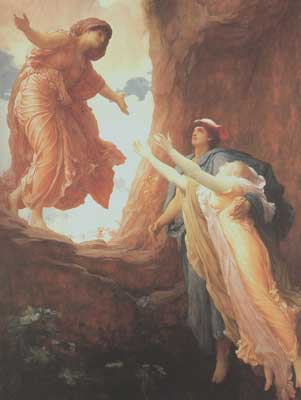
What can we learn here? That l/Love, essential, wonderful though it might be, goes nowhere if it is not tempered by Wisdom, and this is where the Devil comes in. Here we go back to Greek mythology, to the story of Persephone and Hades. As always, I recommend further inquiries on the reader's part, but to sum up, Persephone was the daughter of the goddess Demeter, Mother of the Earth. The stories vary slightly, but the important point is that Persephone is one day abducted by Hades to be his consort. Demeter becomes depressed, and, since she rules over the cycles of the Earth and all the crops, life begins to wither. It is only when a deal is struck that life returns: Persephone is to spend half the year in the Underworld with Hades (fall and winter, when Demeter is sad) and half the year above (spring and summer, when Demeter is with her daughter).

The return of Persephone, by Frederic Leighton

Persephone is astrologically linked to Virgo the maiden (with Demeter being associated with Taurus, ruling the cycles of the Earth). It is only after she is abducted into Hades (Scorpio) that she can move on to complete the yin cycle with Capricorn (material realization) and Pisces (mystical transcendence). Of course, this myth works in many layers, but one of the more important lessons is that it is necessary for a young wo/man to come into contact with the Devil before fulfilling his/her destiny/role. Keeping in mind that Cancer represents the Dark Night of the Soul and that the goat - Capricorn - is frequently associated with the Devil, we see our your virgin surrounded by all this darkness. It is no coincidence that the loss of virginity is so much more traumatic for women - they are confronting a Devil, whereas for a man this is usually seem as a positive step into adult manhood. This does not mean, of course, that men do not have to confront their own demons, but it has to be more of a conscious move on their part.*

This loss of contact with our shadow side has been the rule for many centuries, though you wouldn't get a retort from me if you were to say that we're headed to a more balanced attitude towards the masculine and the feminine (sadly, it's been a rough ride). One of the reasons women have been seen as inferior or as spawn of the devil is exactly because they tend to be much more in touch with their shadow side, which scares the living hell out of men who are caught up in their hubris. The first mistake made by Man was not to eat from the Tree of the Knowledge of Good and Evil (the knowledge of the balance between yin and yang handed to a male human by a snake, another form of the Devil - the picture is getting quite clear here), as the elitists who co-opted monotheistic religious mythology would have you believe, but to assume that he is superior to other forms of life (known as hubris) - a message carefully added to the Bible by said elitists.

The appropriately named Titanic

Taken to the extreme, Man sees himself not only as superior to other forms of life, but sometimes even as an equal of the gods. The gods, however, in their w/Wisdom, have always warned us that we are not on par with them (any archetype - i.e. god - necessarily loses something when it becomes manifest in consensus reality) - a lesson we learned harshly when Zeus split formerly androgynous Man in two. This is what happens when Man relies too much on the masculine principles of rationality and action, while sensitivity and patience sit on the sideline. We must, therefore, come face to face with the Devil, often a traumatic experience exactly because we deny the Devil in us, before we are to make any leeway on the path to Godhood. Sadly, Man much prefers the sweet red apple to the bitter green apple.

If you'll consider the points made in the first part of the series, it's high time we stopped seeing the Devil as something to avoid and started instead to integrate the Devil with Jesus, the inner demon with the inner saint. When we fail to do this, when we project our Devils onto other people or even onto fictional characters (the Joker and Bane are obvious, recent fodders), the Devil feels neglected, and comes out in a wholly unhealthful way, to put it mildly. If we were to take the social memory of Earth into a therapist's office, there would be much to be said about the Earth learning to consciously integrate the shadow side it has long neglected and which keeps manifesting through unconscious outlets. We must remember that Prometheus gave us fire, that is l/Light, l/Love, the ambition to seek Godhood, to serve this purpose, whether through oneself or through others, but not necessarily the w/Wisdom that should go with it. We must not confuse, then, knowledge, which is attained with masculine, active investigation, with w/Wisdom, which is attained with feminine, passive pondering and digestion (note that Cancer rules the stomach). While we do, great advancements in science will always be followed by terrible crimes**.

This is why it is important to see what we can learn from the Devil after it has come out, to let the memes and the ideas sink in, to integrate it so that violence and chaos are used for noble ends. Thus, we move from the goddess Aurora to the mighty oak tree. The Oak was understandably revered by the Celts as a symbol of honour, wisdom and strength. Oaks have been long associated with royalty (the Round Table is supposed to have been made of oak) - oaks are known to be frequently struck with lightning, symbolizing their access to the heavens. In my view, however, the lightning also gives us a warning: grow too tall and you'll pay the price.


The 16th trump of the Tarot, the Tower (previously discussed here), illustrates this. The main lesson in this trump is that we must be careful not to forget yin when we are out yanging. When we have not learned the lessons of the 15th trump, the Devil, we will inevitably be struck with lightning thrown by dispute-settler Zeus. Lightning also brings us back to Prometheus and our misuse of the divine Fire. There is no need to move in circles here, I believe.

This is not to say that lightning is always bad (one could argue there is no such thing). The oak tree was known to the Celts as the door to the inner planes - accessing this higher consciousness was described as "opening the oak door." The point is to remember that being struck by lightning should not be seen as a failure, but rather as a contact with something higher trying to tell us something.


This brings us back to the recent tragic events. It is clear, in both the events of the crimes and the popular/media response, that lightning still causes us to cower in fear. The mainstream media's reporting has been thoroughly superficial, and the alternative seems to be focusing on all the wrong issues (covered here by Chris Knowles). Both analyse these events with a complete lack of l/Love, that is, sending messages of fear (remember that "the only thing to be feared is fear itself). The former describes the murderers as deranged lunatics who could strike anywhere at any time, while the latter describe them as pawns of a sinister group who could strike anywhere at any time. While both pretend to be applying an investigative lens to the tragedies, we clearly see that the focus is truly elsewhere. The bread crumbs lead us to the extreme right and the gun lobby, but the media are clearly still busy discussing the finer points of bread crumb analysis.

While takes us to Milwaukee, the third act in this drama. The origin of the city's name is contested, but there are clear associations to "a beautiful land," "a land by the river," and a "council place." What we can learn here, then, is that we must once again remember to conciliate solid earth with liquid water, cold facts with warm intuition. What we choose to do instead is to bury our heads in the sand. Sadly, this is not to access what might lie underneath, but simply to avoid being struck by lightning.

Milwaukee, complete with phallic Tower and passive water

Wisdom without l/Love (distrusting the consensus, but in fear) leads nowhere, and neither does l/Love without w/Wisdom (passionately defending an unresearched point of view). The Devil is trying to teach us to heed both, but to little avail. Free yourself, then, from the bonds of fear. Look the Devil in the eye, and hear what he has to say. We must all remember that there is indeed a Devil, both inside and out, but this only means that the Devil is a part of ourselves and a part of the world. The key word missing here is responsibility, the concept that will be explored in the third part of the series. For a brief preview of the ideas, check this out. 

One final look through the astrological lens: the Earth is represented in the sign of Cancer, the Imum Coeli of the zodiac wheel. This 4th sign indicates the solid ground we stand on and feed from, our mother (archetypical, not necessarily literal). The opposite sign is that of Capricorn, and it is related, as I've mentioned to the Devil. It is outer achievement and material action (contrary to the emotional digestion of Cancer), the father that kicks us out of the house so that we can make something of ourselves. If the Earth is your mother, don't forget the Devil is your daddy.

Jul 10, 2012

The Pisces Particle

The recent announcement of the alleged discovery of the Higgs boson particle has been met mostly with celebration and reverence, but also with some controversy. In order to understand what's happening, which always goes deeper than what you hear about in the media, I'm going to take a look at the astrological correlations regarding this event.

I was going to post a video as an introduction, but as I opened the YouTube main page, I saw this video. I will post the other one further on, as this is not only the excellent Rap News (which I really recommend, if you haven't seen it yet), but it also sums up the issues pretty nicely.


So the central issue is the Higgs boson, controversially referred to as the 'God particle,' which is the last remaining particle to be proven in the Standard Model of Physics. As we will see, I think it's unlikely that this will ever be confirmed beyond any doubt, as the Higgs boson is associated with Pisces. But first, I'd like to take a look at the video I was originally going to post first.

Who appears on the video preview? None other than God himself.

What strikes me about this Symphony of Science series (if you haven't, check out the other ones) is how distinctly alchemical these videos feel. They take quotations from prominent atheists and scientists and turn them into something that's almost magical. Thus, we can see that what's really at the heart of the matter is not so much a dispute between science and metaphysics, but condescending and defensive mindsets, because all is One. This shows that it's possible to embrace both science and poetry, and that both are really two different ways of seeing the same thing.

You'll notice what Brian Cox talks about: 12 particles of matter, 4 forces of nature. I don't understand how this doesn't seem amazing to anyone who knows their basic astrology. The astrological cycle is composed of 12 numbers (Aries - 1 to Pisces - 12), divided into 4 elements (Earth, Air, Water, Fire). Since the Higgs boson is the last particle to be discovered, we can associate it to the sign of Pisces, the last step of the Zodiac.


The associations go further than that. From the previously linked article, we have this nifty paragraph:

What CERN announced last week was the discovery of a new particle in the correct mass range to be the Higgs, but further analysis of the data from particle physicists at Argonne National Laboratory in Illinois suggests that CERN is just about as likely to have found evidence for more exotic varieties of the Higgs particle, called Higgs doublets or Higgs triplets. These "impostor" Higgs particles are part of a non-Standard Model interpretation of the Higgs concept, where a bunch of different Higgs-type particles (instead of just one) are together responsible for the Higgs field.

This perfectly fits the idea of Pisces, one of dissolution and lack of monads. Pisces is all about merging with the Collective, about surrendering your ego. Pisces, for instance, rules asylums and prisons, where everyone has equal status and is practically anonymous. This is why I believe we're never really going to find one Higgs boson particle, and this concept of a multi-particled Higgs field fits perfectly.

But let's get back to the event. I have superimposed the chart for the public announcement of the particle, on July 4, with the transits representing the one whom the boson is named after, Peter Higgs.


  • What jumps out at first I think is Higgs's Sun @ 7Gem conjoining fortuitous Venus @8Gem and Jupiter @4Gem in the 10th House of public relations. Obviously, he's the star of the event, basically the Father of this particle. This is truly his moment to shine, as Venus (social events) is in close sextile with both Mercury @8Leo (communication, announcements) and Uranus @8Ari (breakthroughs, discoveries). Higgs's North Node @20Tau, less than one degree from the Mid-Heaven, indicates that this is really his crowning achievement.
  • It's also an important moment for materialism, as highlighted by the Mid-Heaven @21Tau. If the Higgs boson is confirmed, so is the Standard Model of Physics.
  • Mars @0Lib in the Second House of money and possessions indicates that there is money to be made in the announcement, as no doubt endless grants will flow towards the LHC and CERN. It is, however, opposite Uranus in the Eighth House of deals and shared capital, so in this moment of economic crisis, essential funds being diverted to theoretical pursuits might not please a whole lot of people.
  • Saturn @22Lib is in the Third House of press and divulging, which fits with an announcement coming from the scientific authorities. It is, however, square the Moon @20Cap, the significator of the public, which shows that the relationship between the public and the figureheads of science might be a bit strained in the long run.
  • This is corroborated by Higgs's Neptune @28Leo conjunct the announcement's Ascendant @29Leo, not to mention the mundane Neptune @2Pis close to the Descendant. This means the waters are being muddied so that someone may profit from the situation, especially in terms of calling for attention. 
  • Higgs is quite close to his Uranus return, but this seems, due to the shades of Scorpio surrounding this aspect, to be foreshadowing a situation where Higgs will die soon, and be posthumously awarded the Nobel prize in Physics, regardless of how this boson situation will end up.
  • Mercury in the Twelfth House of secrets also sets off alarm bells as far as the veracity of the announcement is concerned. This house rules secret enemies, and it seems that the scientific authorities involved in this announcement are concerned with something other than the benefit of the public. This is further corroborated by the Sun @12Can being opposite to the Moon (in fact, some have speculated that the full Moon may have influenced the measurements).
  • The Ascendant @29Leo is quite intriguing. What this seems to signify (I just read a wonderful article about the meanings of the extreme degrees) is that the public is just about fed up with pompous declarations, and will begin to investigate (Virgo) the matter more carefully. I think this will be especially true when it becomes widely known that this confirmation wasn't as final as most have thought.
  • In the end, I believe this will be in the interest of the people (North Node in the Fourth House), but not necessarily in an obvious manner, and certainly won't be immediate (North Node opposite Jupiter and square Neptune). We will come out of this whole story having learned not to trust extravagant declarations made by the scientific elite, but most of this figures to happen quite unconsciously. I can only hope we will figure it out, at any rate.
In conclusion, the general idea seems to be that this announcement is quite significant, but especially for the intelligentsia itself. The public might be celebrating this news at first, but as news trickles in about potential problems or misinterpretations with the Higgs discovery, we will begin to question what's really going on. The more we try to get a grasp on the Higgs boson, the more frustrated we will becomes, and we will hopefully come to a conclusion that sometimes taking things on faith (Pisces) is not just a good idea, it's necessary.

Hat tip to Jeremy Puma at the Secret Sun.

Sep 24, 2011

The Rule of Three

It is hard to define precisely what the universe is, or what our existence means, but one thing I am sure of is that it is made of patterns. The thing is that it is quite hard to see these patterns, for they appear in a number of unconventional ways, that is to say, it is difficult to see patterns that are not the basic patterns we need for our survival.

One such example is the rule of three. I does seem to be very vague or general, but I see it as one of the most basic patterns out of which others unfold. Astrology explains that this rule of three is divided into the Cardinal, the Fixed and the Mutable. With one of each for each of the four elements (Fire, Earth, Air, Water) we have the resulting twelve signs. Aquarius, for instance, is the Fixed Air sign, and it displays characteristics of both.


We can, however, see how this patterns shows itself in different manners. Let us consider for instance the cycle of rain. The Cardinal rivers flow until they reach bodies of water or underground reserves. Interestingly, the Cardinal Water is Cancer, and crabs dwell in or near fresh water, or close to the coast. The water then lies in the Fixed body of water until it rises and becomes a Mutable cloud. The clouds are moved by the Aquarian wind, ruled by Uranus, god of the masses. Of course, two frequent descriptions of Aquarians and Pisceans is that they have their head in the clouds.

This pattern can be found in the fauna as well. The most obvious is the cycle of life of the butterfly. It starts out as a caterpillar (Cardinal), then transforms into a cocoon (Fixed), out of which comes the winged (Mutable) butterfly. The butterfly is a recurring theme here in NoMII, naturally. The cycle works both ways, though, and we see it in pretty much every living species. The Cardinal Egg becomes the Fixed (cannot fly) chick, followed by the winged (Mutable) chick. A human being starts out as a Cardinal baby, turns into a Mutable adolescent and ends as a Fixed adult. Trees are first Cardinal seeds, then grow (Mutable) into full-grown Fixed plants. Insects go from Cardinal egg to Fixed larva and then Mutable adult.

Of course, this doesn't mean that the lengths of these parts should be equal. A man is usually an adult for much longer than he is a baby, for instance. But this fundamental division in three is present everywhere. Matter exists in essentially three phases: Cardinal liquid, Fixed solid and Mutable gas. Even God is divided into three: the Cardinal father, the Fixed (i.e.: comes to Earth) son and the Mutable Holy Ghost. Notice in the picture below how the godhead is divided into three parts, with Jesus carrying a wooden (Fixed) cross and the the Holy Ghost depicted as a winged (Mutable) dove.

Green = Earth, and Cardinal Earth is Capricorn (= old man/father)
Red = Fire, and Fixed Fire is Leo (=jesus)
Yellow = Air, and Mutable Air is Gemini (=messenger-bird)


We can consider, speaking of religion, the division in three between Hades, (Middle) Earth and Olympus. Hell is frequently associated with caves, and rivers are all over it, making it clearly Cardinal, while Heaven is in the clouds, that is, it is Mutable. We are left stuck (Fixed) here on Earth for now.

There is also the essential family unit of Fixed father, Mutable Mother and Cardinal child. The child then becomes either Fixed father or Mutable mother, who then creates another Cardinal child, and so on and so forth. This is where it becomes interesting to consider mythology in archetypal terms, that is, based on the fundamental patterns of the Universe. The pattern is God, simply. Or, if you prefer, God is the pattern. God is not a separate, individual mind, but just a way of showing the essential underneath it all.

This reminds me of the connections I was trying to make between the Planets and the Greek gods of old, which are just different manifestations of a pattern of a higher level. It is hard to really see all of this because our minds are so focused on the three spatial dimensions. Putting all of this into words is quite complicated (thanks Mercury in Pisces), but hopefully this will all give you a glimpse of how I see things, and a (Cardinal) seed will be planted in your brain, growing (Mutable) over time until it becomes a coherent (Fixed) idea.

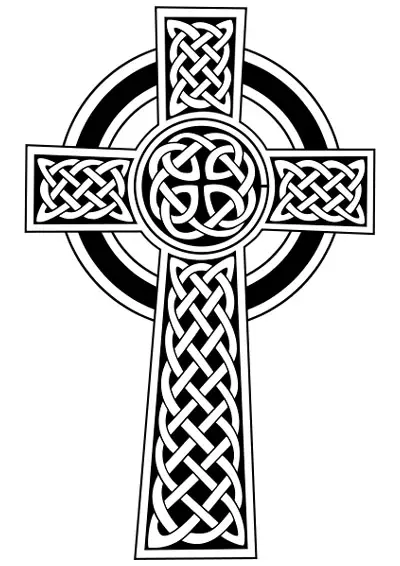
The most basic pattern is the pattern of two (Yin-Yang, Sun-Moon, dualism and all that jazz I've been talking about), which unfolds into a double pattern of two, that is a cross (gee, where have I seen that idea before?). Dr. Roderick Peters mentions in his book Living with Dreams this archetypal cross, explaining how we tend to divide allness into four, as Jung said. Quartering the circle, that is. This can be seen in the four elements and in the points of the compass.

The Celtic Cross

If we apply the rule of three on the Sun Circle, we get the tetrahedron (i.e. four triangles, giving us the same number as the zodiac, the hours on a clock and so on do) inside the sphere, that is, the minimum and maximum volumes. Nassim Haramein gets into more detail about this, if you have the patience. Maybe you will disagree with some of what he argues, but that this idea seems pervasive is undeniable. Perhaps you can see a little bit where I'm going with this? I'm not entirely sure myself, but I'm sure we'll get there.

Update: right after posting I read in the Modern Mythology blog:
Geometries branch. The one world becomes two, and the two becomes eight billion—without ever ceasing to be two. As to the order that hides behind the panoramic flux, Heraclitus says, “The transformations of fire—first, sea; and of sea, half becomes earth and half the lightning flash.” (emphasis mine)

Cardinal sea becomes either Fixed earth or Mutable lightning and...oh, you get it

Jul 21, 2011

Psyche

As I mentioned before, the Greek word for 'butterfly' is 'psyche', which is also 'soul' or 'mind.' Therefore, butterflies are a symbol for the soul, and it is interesting to look at how butterflies appear in art, or even in the common world. For instance, I have just arrived in London, and the main exhibit at the Natural History Museum is about butterflies. Definitely a must-see while I'm here. The butterfly, incidentally, is one of the more common interpretations of some of the blots in the Rorschach test.


The legend of Psyche and Cupid is also worth a look. The story goes that Venus was awfully jealous of Psyche's beauty, so she sent her son Eros (Cupid) to make her fall in love with a hideous creature. He enters into her room, invisible, but Psyche startles him by waking up and looking him straight in the eyes, which causes him to accidentally prick himself with one of his arrows, making him fall in love with her.


Venus, angry at this, places a curse on Psyche, so that she is unable to find a husband. Cupid naturally hates this so he refuses to shoot at anything, meaning that no man or animal marries or mates. The world begins to become old, so after three months Venus allows Psyche to marry again, and all returns to normal. Psyche, however, still can't find a husband, so her parents see an oracle, who tells them to take her to the top of a mountain (Tower) and leave her there, for her beauty is too great for any mortal man. They do so, and then Zephyr, the West Wind, carries her to a valley, where she is attended to, and makes love to an invisible Cupid regularly.


Cupid tells her she can't see who he is yet, but Psyche's sisters convince her to try to find out, which she does. While she is doing so, however, she also accidentally pricks herself with one of Cupid's arrows, and falls madly in love with him. Psyche goes to Venus' temple after Cupid flies away, and asks her for help. Since she is still jealous, however, she orders Psyche to do a series of impossible tasks, but animals take pity of her for her beauty and help her. Interestingly, in one of the tasks she has to reach a location protected by snakes, and manages to do so thanks to an eagle.

Eventually, Venus tells Psyche that caring for her son, who has been depressed due to Psyche's actions, has worn some of her beauty out, so she orders her to steal some beauty from Persephone. Deciding that the quickest way to the Underworld was by dying, she climbs to a Tower to throw herself away. However, the tower itself speaks to her, showing her the way to the Underworld and what to do and what to avoid. She then successfully gets the beauty into the box given to her by Aphrodite. However, she peers into the box before returning it, and falls into a deep sleep as a result. Eros wakes her, and eventually Zeus solves the whole matter, turning Psyche into a goddess.

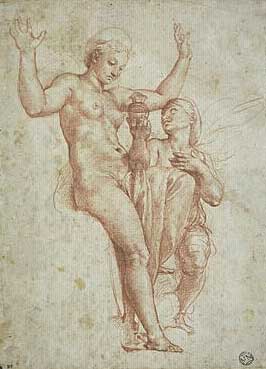
A painting by Raphael. Psyche is often depicted with buttefly wings.

Oh, and Psyche and Cupid have a daughter called Voluptas, which in Latin means 'pleasure' or 'bliss.' That is to say, the union of body and soul results in bliss. If we consider the Greek myths as symbolic (much like many consider the Old Testament to be symbolic) we see that they are not flights of fancy, but true Keys to understanding.

Since I mentioned the Underworld, I thought I would also explore some connections in that direction. The river Styx is the boundary between the Underworld and Earth (or Middle-Earth). It circles Hades nine times (in addition, the gods who break a promise sworn to by the river lose their voice for nine years). In the Divine Comedy, Virgil takes Dante through the nine circles of hell. Perhaps it might be meaningful to see Hades not as a physical hell, but simply the opposite of solar consciousness. In this perspective, Olympus would be more or less the equivalent to the Sun, the ego, while Hades is the unconscious, dark and murky. Remember Psyche has to wander into the Underworld before she can enter Olympus as a goddess.


Olympus is ruled above all by Zeus, but also by eleven other gods, bringing the total to twelve. This is, of course, the same number of signs in both the Western zodiac and the Chinese. It would be interesting to draw a parallel between the gods and the signs, but that is not the point here.

The twleve Olympian gods

Each sign is divided into three decanates, which correspond to the three signs of the element (earth, air, water and fire). We have thus a figure of three in one, or three from one (like Cerberus, who dwells in Hades), forming a tetrahedron. If we consider the six axes of the zodiac and the decanates of the signs, we have six double tetrahedrons, which consist of seven points if we consider the tetrahedrons as having the tip in common. That makes 6 x 7 = 42. I'll admit this is perhaps a stretch, but I'm still feeling my way around all of this, and it seems to fit Nassim Haramein's ideas, which I like a lot (though not necessarily 100%). Also, 42 could be seen as 4 x 2, that is, a tetrahedron twice.

But again the hand of synchronicity waves its wand. I started writing this post yesterday, and news came out that astronomers discovered a new Moon in Pluto, the planet named after our famous Hades. My money is on the name being Cerberus, but that might be just too deliciously sweet. Additionally, though it is unrelated here, Neptune recently completed one full orbit from its discovery in 1846. Neptune seems angry, though...perhaps because no one offered him any gifts? Oh, and just to add the icing on the cake, yesterday it was 42 years since Buzz Aldrin first stepped on the Moon...(and peed on it, which is interesting in light of this Pluto news, given that Pluto is the planet associated with the excretory system)