May 14, 2011

The Lady in Black, pt. 4

I thought we'd venture away from fiction a little bit to analyse these symbols we've been discussing in more immediate incarnations, name in religion. We should start out with the obvious, that is, that there is Sun-worship and Moon-worship, often together, though not necessarily so. Solar deities abound, from Horus in Egypt to Helios/Apollo in Greece to Jesus, well, everywhere. Although it is not always the case, usually the Solar deity is male (exceptions include, for example, Sekhmet in Egypt. Likewise, the Moon deity is usually a female figure, although not necessarily always. In either case, they often appear together, joined together in the crescent moon-star/sun combination, as we see in Islam or again in Egpyt.

The Pakistani flag
Add caption
It would take far too long, however, to list all these connections, and certainly it's been done before. I thought it would be interesting, however, to take a look at some of the figures we see. If we look at Catholicism, there are two main types of servants of the Church: priests and nuns. And what do they usually wear?



Now, I know that there are priests who wear black, but it seems to me those guys are mostly from small parishes and work more with individuals than with the masses per se. If we look at large Catholic masses, the priest usually wears while. We thus have the figures of the White Wizard and the Lady in Black yet again (it's also interesting to note that it is very common for Islamic men to wear white and for women to don black burqas...). And what are their roles? Well, the priest is there to lead the worshippers and enlighten them; the nun, on the other hand, is secluded and mostly prays on behalf of others. Thus, we have the outward (white sun) and inward (black moon) devotees of God...interesting.

On the flip side of the God figure we have the Satan figure, which can also be divided into male and female aspects, the incubus and the succubus. They are creatures who have sex with humans of the opposite sex, usually while they are asleep or while the others in the house are asleep. Note that these are Lunar characteristics (it is important to think of this in a two-dimensional way, as I mentioned in the previous post: the dichotomy goes up and down AND left and right) which we might associate to Satan himself. The succubus is related to the Whore of Babylon figure while the incubus is closer to the figure of Satan, that is, the fallen angel.


What's the point here? Well, the way I see it, these, Sun and Moon, YHWH and Satan, woman and man, are all simply manifestations of an original Singular Consciousness, manifesting itself as dualisms which are in balance. That is to say, the concept of Yahweh would not exist without the concept of a satanic figure. The notion of good is meaningless without the notion of evil. They are in eternal balance. Likewise, we must recognise that these elements exist in all of us, in the sense that no one is purely good or purely evil (insofar as we can define those concepts, which is mighty hard).

In not accepting that there is a Satan inside all of us, just as there is a Yahweh, in believing that humanity is made of pure goodness and justice, we will just end up projecting this darker side of ourselves onto others. This is probably one of the most important reasons why injustice and greed seem to run rampant in society: we are so afraid to acknowledge our own dark side that we need others to express this side so that we may feel balanced. The average man is not inclined to take action against evil because he feels much better purging those sentiments in anyone other than himself.


A classic manifestation of this appears in the puritanical condemnation of sexuality. By repressing one's (entirely natural) sexual feelings, one ends up either covertly manifesting these feelings (in the form of swing clubs, strip clubs, pedophile priests, and so on) or overtly condemning them (i.e.: abstinence programs, the fight against gay marriage, etc...). This creates a fundamental imbalance than ends up manifesting in entirely destructive ways. By ignoring our dark, sexual, Moon sides, we end up transferring all the energy towards one edge or the other; we either radiate our Sun excessively or enclose our Moon, and do not allow it to express itself.

This whole idea is a central tenet in astrology, of course. The whole idea is to find a balance within ourselves. If we do not please our Venus (female energy of attraction) she will become angry, and this is what's happening to society as a whole. Just look at what happens to these energies when they are not manifested: pedophiles are denied their sexuality and end up molesting children; teenagers are denied their sexuality and end up pregnant at 16 (in fact, church youth camps are literal breeding grounds for teenagers).

The same happens, to give another example, to a denied Neptune. In not acknowledging that drugs are an important element in society, in banning them, their expressions end up distorted and Neptune becomes angry. We fail to recognise this in outlawing drugs, that is, we are denying a part of ourselves when we believe that drugs have no place in human society. After countless years of the War of Drugs and of drugs being illegal everywhere, has drug use around the world fallen by even a bit? Of course not. We have, though, many more overdoses and drug-addled rage incidents than we ought to. That is not to say that everyone has a need for drugs, on the contrary. But to deny those who do this need only leads to a destructive expression of their desire.


So if religions, at their outset, recognised that our world functions as a dual system, in which both Sun and Moon need expression, why can we not? It is time to see that God is not Yahweh nor Satan, but BOTH, and if either is denied we only end up getting the extremes, which are damaging to all. In the Odyssey, Poseidon becomes angry that he was not thanked after helping the Greeks win the Trojan War, and thus diverts Ulysses' journey so that it takes him much longer to finally get home. If a God (within or without) is not acknowledged, it will lash out in fury. The Greeks seemed to know this; how can we consider ourselves more advanced if, in spite of all our technological innovation, we are still entirely unable to deal with our inner selves? The Gods are not out there, they are inside us, whether we like it or not. Why do the incubi and succubi attack while their victims are asleep? Well, when they are asleep they cannot rationalise their sexual desires, and are thus much more open to them, practically inviting the demon to possess them. Perhaps it would be wise to think of mythological stories not as explaining the outside world, but rather the inner.

May 11, 2011

The Lady in Black, pt. 3

Following on the ideas of the previous post...

The four figures mentioned before can be organised a square, or rather a cross inside a square. One line of the cross would represent the male/female dichotomy, the other the sun/moon dichotomy. The four archetypes are then the four corners of the square: the female moon is the Lady in Black, the female sun the Lady in Red (the colours are no accident), the male sun the White Wizard and the male moon the Black Warlock, or Dark Magician.

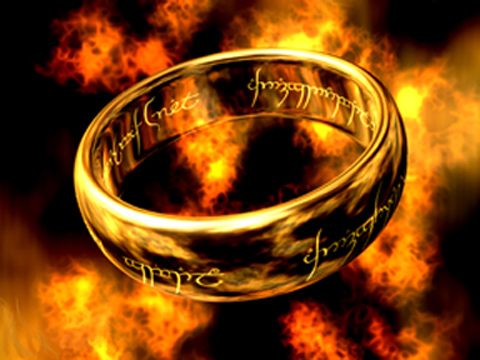
Remember the previous picture of Arwen, the Lady in Black in the Lord of the Rings series? She appears at a river, which is interesting given that water represents emotions and the subconscious, as does the Moon. I think it might also be appropriate to consider One Ring as the representation of the Lady in Red. It is temptation, selfish desire and greed embodied in Bilbo then in Frodo. It's hard to resist the seductress. A separate post would be required for a more detailed reading of the series, though.

From fire it was created, in fire it is destroyed...

The Lady in Red also famously appears in the Matrix. The Lady in Red, or the Lady in the Red Dress in this case, is the temptation to remain in the Matrix, to give in to lust and greed, and all the cardinal sins, really. It is the desire to remain materialistic, to give in to your emotions rather than understand them. Agent Smith is the Dark Magician, using essentially what is magic to replicate himself. It is the desire for ultimate power and control, regardless of the consequences. The other duo is easily Neo (WW) and Trinity (LB), although they also present, along with Morpheus, an interesting Father-Mother-Son triad (like Mars-Venus-Mercury, God-Holy Spirit-Jesus, Osiris-Isis-Horus, and so on), but that's also for another post.


This archetypal analysis is very simple, of course. The point is mostly to show the power of symbols, and how they show that many things are actually reduced to a few basic components. This is the same with astrology, tarot, and so on (the credible ones, of course). There's a level deep down, though, where all those become one and the same. Is it possible to even to glimpse that far down (or up, depending on your point of view)? Well, not by purely rational means, certainly.

Coming back to the relation between water and emotions/the subconscious. We call on our good friends Uriah Heep again to enlighten us:


It's interesting that I (and most of you as well) have been remembering my dreams more often lately, and often water is an important leitmotif. Friends have been telling me this as well. This should not be surprising, however, because Neptune is now back home in Pisces...prepare for more water during your slumber. But I digress.


If we think of the figures' connections to animals, it follows naturally the White Wizard is connected to the eagle, as show Gandalf and Jake Sully in Avatar. Conversely, the Dark Magician is associated to the snake, such as Voldemort in the Harry Potter series. Reminds me of the Medusa/Pegasus story...the Dark Magician also has Raven connections, and White Wizard to the Lion (cf. Aslan, astrology), while I'm inclined to think of the cat for the Lady in Black (Hermione and McGonagall in Harry Potter).

Well, I feel like if I keep going so succinctly this is going to get confusing. Then again, more figures are coming soon...

Apr 8, 2011

The Raven, or the Fall, pt. 1

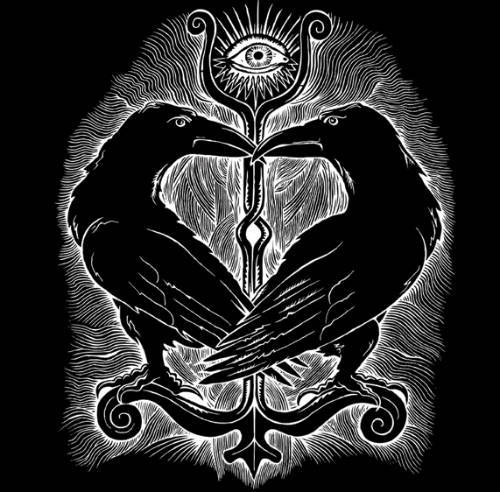
Today I have been led to do a little exploration of the myths behind the Raven (or Crow, obviously). I have come to see the Raven as the polar opposite of the Swan. They are the two sides of the same coin, dealing both with life and death. The Swan represents the ascent into heaven, the rebirth of the dead, whereas the Raven is the opposite journey, that of heaven down to Earth, or of Earth down to Hades.


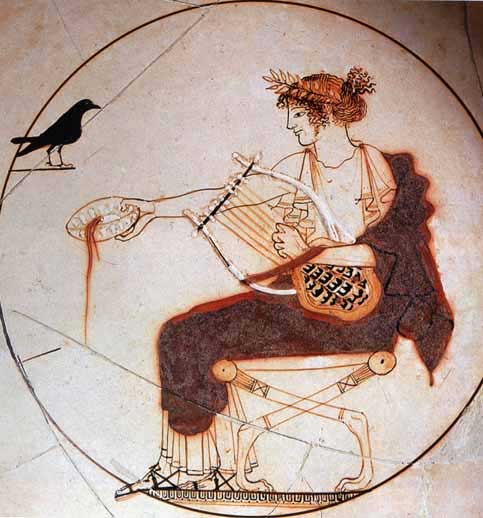
In Greek mythology, the Raven was an assistant to Apollo, the Sun God. Apollo was also the god of prophecy, and thus the Raven is associated to prophecy, that is, to the future. There are two versions of what happened to the Crow. In the first, he discovers that Apollo's mistress was cheating on him, and tells the Sun God. Apollo, however, is not happy, and accuses him of being a tattler. He then turns the Crow from silver (that is, a being where black and white are balanced) into black, and sends him into Hades. We have here, then, a story clearly associating the Raven to death, to the fall. The androgyne is now split.

In the second version of the story, the Raven is sent for water with a cup. He then loiters at a fig tree until the fruits are ripe (or, otherwise, eats the figs). Since Apollo would be mad about his delay, he carries it a water snake, or Hydra, and uses it as an excuse. The god doesn't buy it, though, and thus casts the Raven, the Cup (Cratera) and the Hydra into the sky. He punishes the crow by making him eternally thirsty, tantalisingly close to the water in the Cup, which is protected by the Hydra. So once again, while the Crow does technically go upwards, towards the sky, it is still a fall, for he is punished and eternally condemned (ergo, he goes to Hades, in a way).

Notice the lyre...


It is also interesting to look at the Crow's role in North American mythology. According to some beliefs, the Raven is the creator of the world. The story goes that the Raven got bored, so he took a stone and flew with it in his beak. He got bored, though, also of carrying the stone, so he dropped it, and it became the land where humans would live. Notice how here we also have a fall, this time down to Earth.

There is also the idea of the Raven as a trickster (curiously, in Norse mythology the Raven is associated to Odin rather than to Loki). In this myth, the Raven, once again bored, decides to free some creatures, men, from a clam (I don't think I need to explain the symbolism in that one). He sees, though, that they are scared and timid, and decides to return them to the clam, before actually deciding to search for the women, who were found in a chiton (a marine mollusk). The ancestral Raven, therefore, understands the dual nature of the universe.

We seem to come upon a cycle that would go somewhat like this: Raven -> Human -> Swan. The fall from heaven and the subsequent return. There is more:
In one common North American story, Raven plays a vain and regretful Chief in a moral tale somewhat analogous to The Little Boy who Cried Wolf.
As told by the Ktunaxa (Kutenai), the people tried to convince Chief Raven that everyone should get two lives. But Raven (also the bird/manitou Raven) selfishly preferred that people and animals only get one life. This is because Raven is known to like eating the eyes of carrion. As Raven was chief and had spoken, the decision was accepted.
The people were upset, however, and decided to make Raven regret his decision. Raven's son was killed in an arranged arrow target-practice mishap. A tree was felled that struck and killed his daughter.
When this happened, Raven tried in vain to reverse his decision so that everybody would get two lives. But he was reminded, "You are the chief, and you've already spoken".

Yet again the fall from two to one. The Raven thusly interrupts the duality, which leads to his (our) fall down to Earth, or even to Hell. In the Talmud, the Crow is one of the animals who decide to copulate during the Flood, and is thus punished. The duality of the Crow is broken, and he falls. Remember that the Raven is considered to be an unclear animal, that is, impure (incomplete, or imperfect)

It is interesting to come back once again to the Knights of the Zodiac. In it, the Crow Saint (Knight) is called Jamian (Hebrew for "the right hand of opportunity"). He kidnaps Athena, and is stopped by Seiya, the Pegasus Saint and protagonist. How does he die? He falls into a precipice. In the manga, he is defeated by none other than Ikki of Phoenix.


Returning to Norse mythology, the Raven is associated to Odin in the form of his two pet informers, Huginn ("thought") and Munnin ("memory"), who scour the world for information to bring back to Odin (don't forget Odin supplies the Gandalf, or White Wizard archetype).


So not only do we have once more the primordial Raven as a dual entity, we can make an association to the concept of humans living on Earth to learn lessons, to think and acquire memories, to learn, and thus leave the Samsara and return to Heaven once more. The poem goes (this is but one of many translations):
The whole world wide, every day,
Fly Hugin and Munin;
I worry lest Hugin should fall in flight,
Yet more I fear for Munin.
That is, it happens that one could lose the capacity to think, but it would be tragic for a soul to lose its memory. This could also be interpreted as a fear of losing the dual nature.It is also curious that the two Ravens are bestowed the gift of speech for their services.


 Elsewhere:
  •  In Chinese mythology, the Raven is a solar symbol (Apollo). Supposedly, the three-legged Raven lives in the Sun, representing its three phases (related to the astrological Cardinal, Fixed and Mutable phases);
  • In Aborigene legend, the Raven is punished (charred black) for trying to steal the fire from the Pleiades; 
  • To the Egyptians, the Raven represents destruction (fall);
  • In Celtic lore, Ravens are associated with the Morrigan and Morgan le Fay, in addition to being tricksters. The Crow is also the favourite of the Sun gods of the region. 
 Furthermore, Ravens are associated with astral travel, as in the following chants:

I shall go into a crow
with sorrow and such and a black thraw
And I shall to in the Devil's name
Until I come home again!
---
Crow, crow, crow God,
Send Thee a black thraw
I was a crow just now
But I shall be
in a woman's likeness even now
Crow, crow, crow God,
Send Thee a black thraw!
Ravens are, as mentioned before, prophetic birds. The old rhyme says:


One for bad news,
Two for mirth,
Three is a wedding,
Four is a birth.
Five is for riches,
Six is a thief.
Seven, a journey,
Eight is for grief.
Nine is a secret,
Ten is for sorrow.
Eleven is for love,
Twelve - joy for tomorrow.

Twelve, just like the Zodiac, and the number of hours, and months, and so on. The first two are particularly interesting.

Well, that's it for now, but I'll be revisiting the figure of the Crow, especially as it relates to the Swan, and possibly other symbols.

Mar 21, 2011

The Lady in Black, pt. 2

Continuing the idea for the first post about the Lady in Black, I'm going to talk a bit about her male counterpart, the white wizard. While the Lady in Red is the polar opposite of the Lady in Black, the White Wizard is what I'll call her complementary opposite. The Lady in Black opposes the Lady in Red in her intent, but with the White Wizard the opposition is in the means through which the intent is carried out.

The White Wizard is the Sun to the Lady in Black's Moon. While she operates in darkness, he is an action man, and isn't afraid of being in the spotlight. Their purpose is the same, but their modus operandi, so to speak, is certainly not.

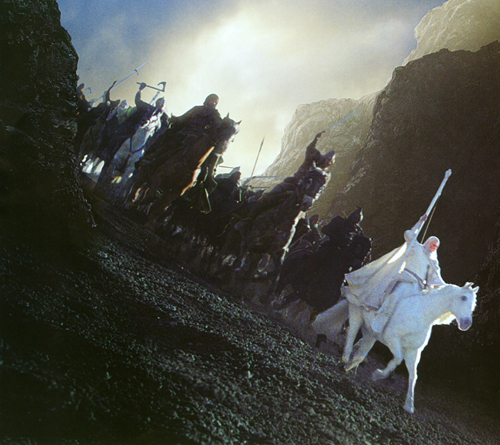
The first example that comes to mind of this idea is, naturally, Gandalf, of the Lord of the Rings trilogy. We must make a distinction here, however, between Gandalf the Grey and Gandalf the White. The former was a wizard, yes, but he was still a mortal man, and actually fell to the Balrog; the latter, on the other hand, was otherworldly, and existed more as a spirit than as a normal man, much as the Lady in Black does.


The Wizard's opposite, I imagine, would be a figure such as the Black Warlock. Of course, these are all just manifestations of some divine will. In LotR this would be Sauron/Saruman.


Notice how Sauron creates his army by means of cold, hard science, breeding these quasi-mechanical creatures out of factories. This is how this negative (relativistically speaking) side operates: by logic, cold science. This is in opposition, of course, to the subconscious, emotional way the Lady in Black and the Wizard act. In LotR, I believe we see the Lady in Black in Arwen. In the film, she first appears in order to save the Fellowship (riding a white horse, like Gandalf).

And with the required black garment

I have to watch the movie again in order to expand on these ideas a little more, however. Returning to the figure of the Wizard, then:


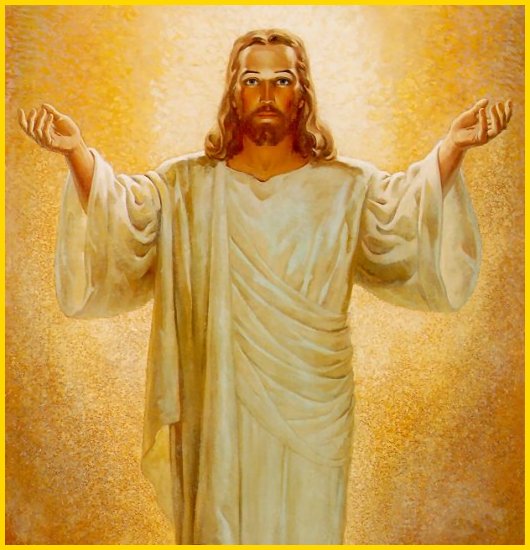
He is, of course, a magic man. He shines like the Sun and performs miracles. There is a parallel with the Lady in Black in that they both work with emotion (remember the Wizard inspires courage among men). Does this remind you of anyone?


It's interesting that, like Gandalf, Jesus dies and is reborn, but he comes back different. He is no longer a mortal man, he is an embodiment of a supernatural force. And he comes, of course, to save men. The association to Aslan here is obvious, especially because C.S. Lewis did it on purpose. In Narnia, however, the whole resurrection thing seems a little clumsily handled.

The rest here is a little obvious, with the whole white-robes, shining thing and so on. More on this mythology in a later post...

Mar 12, 2011

Do you realise?


Do you realize
That you have the most beautiful face?
Do you realize
We're floating in space?
Do you realize
That happiness makes you cry?
Do you realize
That everyone you know someday will die?

And instead of saying all of your goodbyes
Let them know you realize that life goes fast
It's hard to make the good things last
You realize the sun doesn't go down
It's just an illusion caused by the world spinning round

Do you realize?
(Oh, oh, oh)
Do you realize
That everyone you know someday will die?

And instead of saying all of your goodbyes
Let them know you realize that life goes fast
It's hard to make the good things last
You realize the sun doesn't go down
It's just an illusion caused by the world spinning round

Do you realize
That you have the most beautiful face?
Do you realize?

Just as a point moving along a circle never reaches the end, neither do we. The sun going down is not an entry into a world of darkness, but part of the cycle. I find that the word "realize" here takes on multiple meanings. "Do you realise" can be understood as "do you perceive" or "do you notice," but it can also be seen, in my view, as "do you make happen," "do you turn real."

This is a song that has always had a special meaning to me, even if there is no particular association to a person or an event. It just speaks to me on a very deep level. It's hard to make the good things last: we cannot stop the sun from disappearing under the horizon, just as we cannot stop a loved one from dying. It is all just an illusion: an impression we get from the natural cycle of the Earth. When one dies, he does not disappear, but merely moves on to the other side of the coin that is this existence of ours, in terms of the life/death cycle.

Realising that everyone you know someday will die should be a cheerful thought. Obviously it is much harder to actually REALISE this concept, but therein lies the beauty of it. It is hard to let things die, but we must go on and see the beauty in it. This brings Japan to mind. The Japanese have a much healthier relationship with death than we Westerners. In Japan, a cemetery is a pleasant environment, full of beautiful cherry trees and charming brick paths under the shade. It is a place for picnics and romantic walks. It is not ghastly or creepy, for death is simply just a part of life, one that we must deal with sooner or later; and the more we see death for what it really is, the more we come to appreciate it.


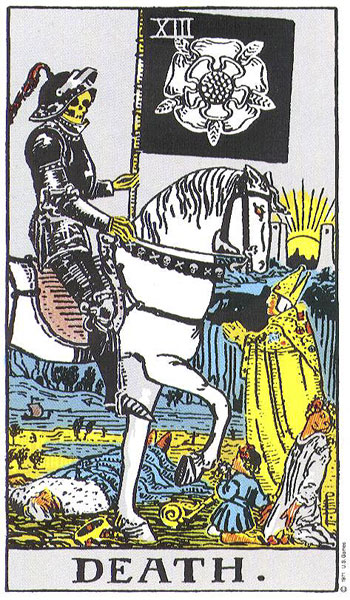
This is all reflected in the Death card in tarot. Many mistakenly suppose it to be a terribly negative card, but it is not. It is the great unknown, the beautiful unknown. Granted, beauty is not what comes to mind when one contemplates the figure on the horse, but look rather at the flag it bears. Why else should a skeleton carry a banner depicting a blossoming flower? Out of death comes rebirth.

In the same way, one must not see the dead person underneath the horse as sad. This only shows us that once we die, our material possessions do not go with us. They are not a part of our life/death cycle. It is only our memories, our thoughts, our feelings that travel along with us. And continually do we travel. The boat in the background is merely in the beginning of its journey. Death has arrived, but it is simply a part of the cycle (notice the three people of different ages).

And what do we see in the horizon? The sun rising.

Dealing with death is always going to bring pain and suffering, that is inevitable. But it is also inevitable that a rebirth will follow. We must learn to deal with these pains and to accept them as part of the endless cycle.

Notice the Sun rising in the background here as well.

The sign most closely connected with the Death tarot card is obviously Scorpio. Scorpio is probably the most dualistic sign of the Zodiac, in my conception. Sure, we have Pisces and obviously Gemini, but Pisces is more about coming full circle, and Gemini is more about the realisation of other. There is also Libra, but Libra weighs, it does imply a dualism but rather a synthesis. Scorpio, however, is the extremes, the two opposing sides of the same coin.

Scorpio is constantly shifting between its two incarnations, the eagle and the snake. The snake crawls along the ground, seeing only what is directly in front of it, feeling only what is below. It is near-sighted, and comes from the earthy emanations of Virgo. The eagle, on the other hard, is far-sighted. It soars high, feels the wind under its belly, sees everything around it. However it does not distinguish detail. Here we are moving to the soaring heights of Sagittarius. In fact, Scorpio is characterised by this extreme dualism. It is not about achieving a synthesis, it is not about contemplating the other. It is about visiting the two extremes, being the snake, dying, and becoming the eagle, and on and on.

And this is the life and death cycle. This is transformation. We are forever shifting from one extreme to the other (at different speeds, different rates, of course), so it is only right to embrace this cycle of transformation and see the death of the snake as the birth of the eagle, and vice-versa.


Another way of seeing this is the mythical story of Perseus. Here we have Medusa, the scary gorgon with its emanations of death and head full of snakes. However, when Perseus slays it (that is, when death arrives), the Pegasus, with its eagle wings, bursts forth from Medusa, and Perseus flies high.

Death is not only normal, it is necessary. It is not easy to embrace this Scorpionic energy...but then, if it were easy, why would we be here?

p.s.: see how the song is 3:33 long - I will comment more on this number in the future.

Feb 26, 2011

Twoness

As you can tell, one of my main points of interest is the concept of dualism, in the sense of black and white and the grey area in between. The opposite poles of a dualism are inextricably bound, opposites that cannot be defined except as in relation to each other. This is expressed well by a magnet: the north and south poles are opposites, but cannot exist without the other. There is no one-pole magnet.


This is expressed well in the dualisms in astrology, the antagonised signs. What I'm doing here is more for self-clarification than anything, but I hope you see where I'm going, and please correct me if I say something stupid.

One such opposition is that between Aquarius and Leo:
  • Aquarius is a fixed air sign, and Leo fixed fire;
  • The greatest contract between the two is that Leo is the ego and Aquarius is the collective. Leo focuses on the self, while Aquarius focuses on the community;
  • They are both, however, leaders; opposing leaders. Leo is the king, and Aquarius the leader of the opposing forces or party or what have you. Leo as fire attracts attention to himself, while Aquarius as air permeates everyone;
  • Aquarius is the shadow of Leo, thus Aquarius can also be seen as the Vizier, the king behind the king.
  • Leo rules from the heart and feeds on emotional courage, whereas Aquarius is cold and rational and works objectively;
  • One cannot exist without the other, it has no meaning without it; thus deep down Leo is motivated, as king, by a love of his subjects, and Aquarius is fueled by a desire to be recognised;
  • Leo anatomically represents the heart, and Aquarius the circulatory system; thus, Leo is the central engine that pumps vitality into the system, and Aquarius the means to carry this vitality throughout the system;
  • On their dark sides, both tend to be dictatorial;
  • The middle point, or balance of this opposition is the ruler who serves others, while not forgetting that in order to lead others one must first lead one's own life.
This idea is embodied in the sign of pisces. Pisces is two fish swimming in opposite directions; it is the sum of the sides of a polarity, the coming of a full circle. It also appears in Libra and Gemini: at first, there is realisation of the other, seeing the two sides of coins; then comes an attempt to balance this opposition, to harmonise it; finally comes a conciliation of the two opposites, in the last sign of the zodiac.

The 11th sign is Aquarius; it is ruled by Saturn, the gatekeeper into the next realm, and Uranus, the change in consciousness. When reaching the 12th house, we find Neptune, this illusory sense of the otherworldly. Beyond lies only Pluto, where there is transformation and rebirth.

(Naturally, today all the planets are either in Cancer or Capricorn, opposing signs, except for Jupiter and Saturn, respectively in Aries and Libra - also opposing signs -, and Neptune in Aquarius.)

This is all true to a much higher degree than astrology, of course. This concept of dualism is something we must face every day, and in fact we ourselves are the products of dualisms; we are slowly but constantly shifting as points in different arrays.

Feb 21, 2011

This is the dawning...

So not only is trouble brewing in Wisconsin, a South Carolina lawmaker wants his state to adopt an alternative currency (and, eventually, secession):

The state, which has never been a fan of federalism, has decided to embark on a new action to buck Washington. Their new idea? The South Carolinian Doubloon.
“If folks lose faith in the dollar, we need to have some kind of backup”, Tea Party Republican and State Senator Lee Bright explained. It is his proposal for the legislature to create a joint committee from the Assembly and State Senate to study the “feasibility” of an alternative currency.
Bright’s legislation states that the U.S. monetary system is headed for full-scale collapse. “Many widely recognized experts predict the inevitable destruction of the Federal Reserve System’s currency through hyperinflation in the foreseeable future.”
Bright’s effort is all in part of his larger plan to crate an independent South Carolina Republic. He was recently quoted by a local paper, “If at first you don’t secede, try again.”
Others in the state, however, believe it is a waste of time. Phil Bailey of the Senate Democratic Caucus wondered how the study will be funded, “Will they be paid in actual dollars or gold doubloons?”
Although gold doubloons would be pretty cool to collect, we here at D+T would like to see South Carolina stay in the Union. Mainly for the reason that we just finished our state quarter collection, and we have become pretty attached to collector’s map.
Kyle Daley, Death & Taxes 

So there is a call for freedom in the land of the free man. I believe we're getting serious reverberations here from the upcoming Age of Aquarius. Why? Well, if we look at how the ages affect religion, for the last two thousand years, we have been in the Age of Pisces. Religiously, this means it's about veneration, self-sacrifice and looking for the answer above, leading to a parental construction of God. This is what we have in Christianity and Islam, the dominating religions of the past twenty centuries. The Age of Aquarius, however, is about the collective. It is no longer about a relation to God and to others that is mutually exclusive, but a relation that considers God and others and oneself as all being one.

We are seeing these themes manifest in other growing areas, such as environmentalism and nutritional holism. These philosophies advocate looking at the Earth and our environment as part of one giant collective self. The film Avatar shows this in a much more literal sense, but it's a good example of what I'm talking about: we have this collectivity represented by the being Eywa. I'll explore the movie in a future post, relating it to Aquarian themes.


This all ties together with the revolutions in the Arab world. This is something that hasn't been limited to Tunisia and Egypt only, it is happening in many, many countries (Morocco, Libya, Yemen, Bahrain, Saudi Arabia, Sudan, Djibouti, possibly others). We are seeing here the power of the collective again. The Egyptians and Tunisians have shown the world that the collective will ALWAYS be stronger than the individual, so long as the collective does not become an individual in and of itself.

In the Age of Pisces, we looked to the skies for the answers and for paradise. Now, in the Age of Aquarius, we will realise that heaven is down here on Earth, and that God is not an abstract figure in the skies, but the sum of the collectivity here on Earth: the people, the environment, the planet.

p.s.: as an interesting note...in the film 2012, there is a massive polar shift, and the new South Pole ends up in Wisconsin. Hmm, change in polarity, massive disruption, Wisconsin...Guess that's another movie to add to the list.